Table of Contents
Best format to deliver 2-minute speech topics for students 30+ 2-minute speech topics for students Speech topics for students 2-minute speech topics for kids: Unique speech topics for students How to choose a 2-minute topic that scores well Common mistakes in 2-minute speech topics for students (and fixes) Delivery tips to sound confident in 2-minute speech topics for students Final Thoughts FAQs
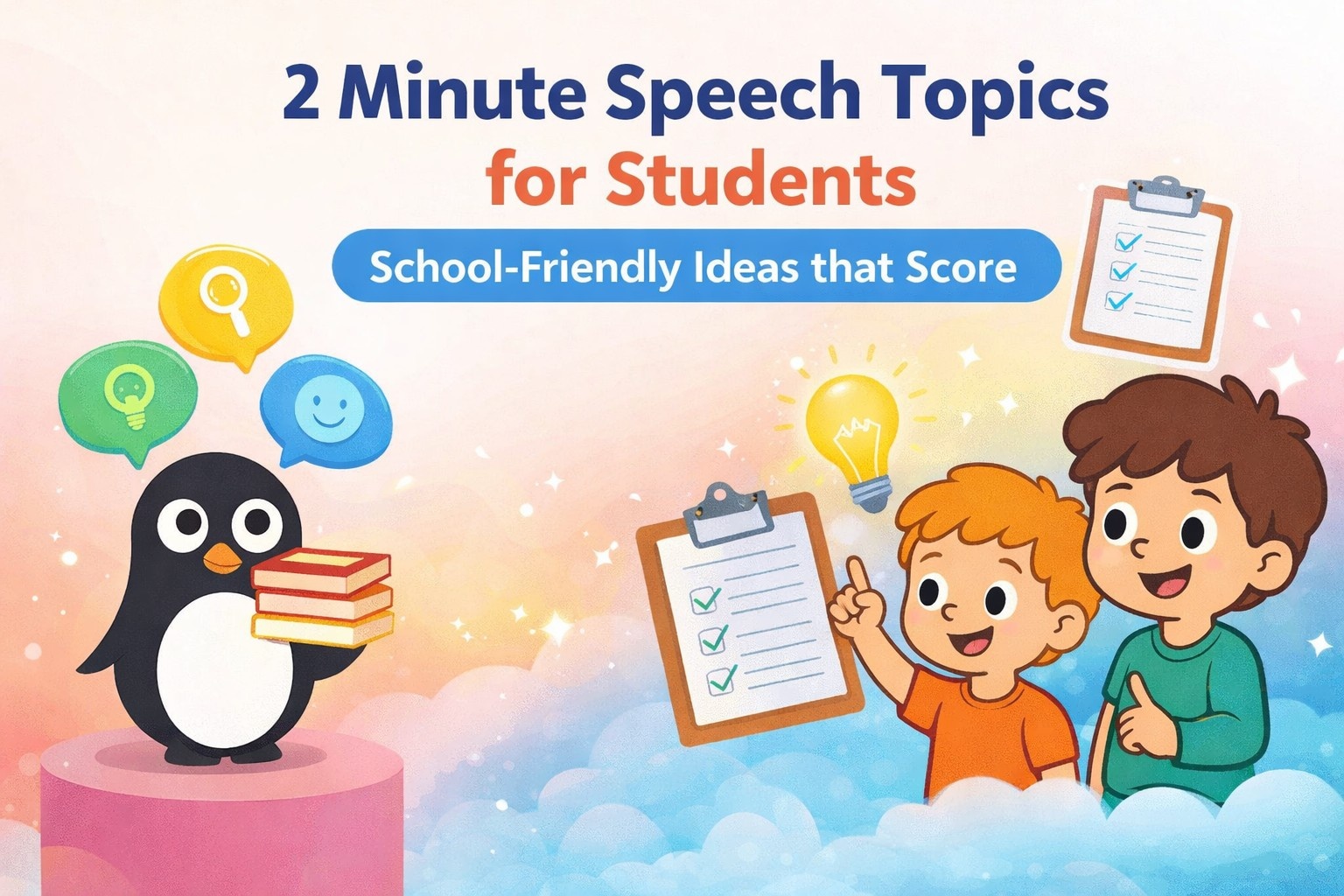
Is your child stuck or confused about what to speak about in the assembly, the classroom, or a competition? You are not alone. Many students have great ideas, but they struggle to pick a topic that is easy, school-friendly, and fits perfectly in 2 minutes. And as parents, you want something even more important – you want your child to feel confident, speak clearly, and score well.
This blog shares 30+ 2-minute speech topics for students that are simple to prepare and easy to deliver. You will also find a high-scoring 2-minute speech format, speech topics for students by category and event type, and unique speech topics for students that help your child stand out without sounding controversial. Along the way, we have added quick pro tips and fun facts to make this guide practical and easy to use at home.
⭐Best format to deliver 2-minute speech topics for students

Mini sample outline (2-minute speech blueprint):
- Hook (10–15 sec): Ask a question / share a surprising line.
- 2–3 Points (70–80 sec): Share your main ideas in 1–2 lines each.
- 1 Example (15–20 sec): Add one real-life moment (school/home)
- Closing (10 sec): One takeaway line + thank you
Quick example (topic: kindness):
Hook: “Have you ever had a bad day and one kind word made it better?”
Point 1: Kindness builds trust.
Point 2: Kindness makes friendships stronger.
Point 3: Kindness improves the classroom mood.
Example: Helping a new student feel included.
Closing: “Kindness costs nothing but means everything. Thank you.”
✅30+ 2-minute speech topics for students
Choosing the right topic is half the work done. The best 2-minute speech topics for students are easy to explain with 2–3 points and one example. They should feel familiar with the topics so students can speak naturally, not like they are memorizing a textbook.

Below are speech topics for students grouped into helpful categories, so parents can quickly pick what fits their child’s style.
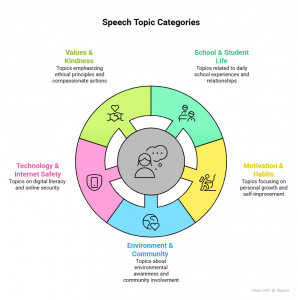
🧑🎓 Speech topics for students: School & Student Life
These topics are relatable because students experience them daily. They also work well for assembly and classroom speaking.
- Why punctuality matters in school
- My favorite teacher and what I learn from them.
- The importance of discipline as a student.
- How teamwork helps in school projects.
- What I love about my school
- How to be a good classmate.
- The value of homework (when done right).
- What I learnt from a school mistake
🌱 Speech topics for students: Motivation & Habits
These topics feel positive and help students sound confident and mature.
- Small habits that lead to big success.
- Why practice is more important than talent
- How to stay focused while studying
- The power of a positive attitude.
- Why consistency beats last-minute effort
- Learning from failures without giving up.
- Setting goals and achieving them.
- Why time management matters for students
🧑🤝🧑🌍 Speech topics for students: Environment & Community
These topics are easy because they fit a “problem + solution” format.
- Save water, save life.
- Why we should plant more trees
- Say no to plastic bags.
- Keeping our school and neighborhood clean
- The importance of recycling.
- How small actions can protect nature.
- Why we should not waste food
- Caring for animals in our community.
🛡️+🔒+💻 Speech topics for students: Technology & Internet Safety
Modern, useful topics that students can speak on with simple examples.
- Using mobile phones wisely.
- Why screen time needs balance
- Internet safety rules every student should know.
- Why is cybersecurity harmful?
- Strong passwords and why they matter.
- How technology helps in learning?
- Social media: good, bad, and smart use.
- Think before sharing online.
✨ Speech topics for students: Values & Kindness
Values topics score well because they feel meaningful and easy to connect with.
- Kindness is a real strength.
- Honesty builds trust.
- Respecting parents and teachers.
- Why gratitude makes life better
- Helping others without expecting rewards.
- The importance of sharing and caring.
- Being responsible at school and at home.
- Why empathy matters
🎤 Speech topics for students
Sometimes parents already know the situation: the child has to speak in assembly, class, or a competition. This section helps you pick faster, based on where the speech will be delivered.
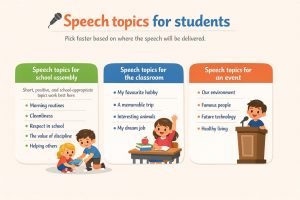
Speech topics for school assembly
Short, positive, and school-appropriate topics work best here.
- The importance of a morning routine.
- Cleanliness is everyone’s responsibility.
- Respect and good behavior in school.
- The value of discipline.
- Why we should be punctual
- Helping others in school
Speech topics for classroom presentation
These topics allow 2–3 points and one real example easily.
- My favorite book and what it taught me.
- A hobby that makes me better.
- What I learned from a challenge
- Why teamwork improves results
- How I manage my time after school
- Why curiosity helps learning
Speech topics for competitions
Competition topics feel stronger when the student shares an opinion and a simple solution.
- Should students have fixed screen time limits?
- How can we stop bullying in schools?
- Should homework be reduced?
- Why we should learn life skills in school?
- How students can protect the environment?
- Why kindness should be taught as a habit?
✨ 2-minute Speech Topics For Kids: Unique Speech Topics For Students
If your child wants to stand out, these unique speech topics for students help them sound fresh without being controversial. Unique topics often impress judges because they feel personal and interesting.

Speech Topic For Students: Unique Topics On School Life
These topics feel different because they use a fresh angle on everyday school life.
- The most important lesson school taught me (not from a book).
- Small habits that make a big difference every day.
- The confidence to ask questions in class.
- What my schoolbag says about my habits
- Why listening is a hidden superpower?
- A rule I did not like, but now I understand.
- What I learned from helping a junior?
- Why friendships change us for the better
Speech Topics For Students: Unique Topics On Science & Tech
Modern topics that feel creative but are still school-friendly.
- One invention that changed student life.
- Why learning coding is like learning a new language
- How AI helps people in daily life with one simple example
- Why privacy matters online?
- The pros and cons parts of technology
- How the internet can be a good place (if used right)
- Why digital habits matter as much as real habits
Speech Topics For Students: Unique “What If” Topics
Fun, imaginative, and easy to structure with 2–3 points.
- What if schools had no exams?
- What if we could pause time for one hour daily?
- What if kindness were a school subject?
- What if every student had a robot helper?
- What if we could grow food in classrooms?
- What if everyone followed the same daily routine?
- What if we could trade one bad habit for a good one?
- What if we could delete one fear forever?
✅ How to choose a 2-minute topic that scores well?
A high-scoring topic is not the hardest one. It is the one your child can explain clearly with 2–3 points and one example. Use this quick checklist before finalizing any topic.
Quick scoring checklist (Parent-Friendly Table)
| What to check | A good sign |
| Topic clarity | A child can explain it in 1 sentence |
| Number of points | Only 2–3 points |
| Example | One school/home example available |
| Simple words | Easy to speak without reading |
| Timing | Finishes in 1:50–2:00 |
| Ending | Strong takeaway line |
Book a free class: Get guided practice to choose topics, build structure, and speak with confidence.
⚠️ Common Mistakes In 2-minute Speech Topics For Students
Many students lose marks because the speech becomes too broad or sounds memorized. The good news is that these are easy to fix with small changes.
- Too broad: Narrow it down (Example: “Environment” → “Saving water at home”).
- Too many points: Keep only 2–3 strongest points
- Memorized tone: Learn keywords, not full sentences
- Weak closing: End with a takeaway and one strong final line
Delivery tips to sound confident in 2-minute speech topics for students 🎯
Confidence in public speaking comes from practice and small habits. When your child slows down and adds a pause, they instantly sound clearer and more confident.
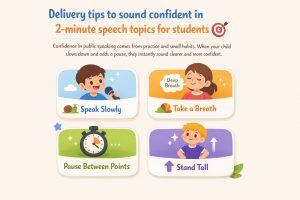
Speak in a confident way
- Speak slightly slower than normal conversation (so every word is clear).
- Pause after the hook (1 second) and pause before the last line (2 seconds).
- Say the first and last line louder than the middle (strong start + strong finish).
Body posture (How To Stand)
- Stand straight with feet shoulder-width apart.
- Keep shoulders relaxed (not stiff).
- Keep your hands out of your pockets and avoid fidgeting.
Facial expression (Look Friendly, Not Blank)
- Start with a slight smile.
- Match your face to the message:
- Happy topic → lighter expression
- Serious topic → calm, focused face
- Avoid over-expression – just keep it natural and attentive.
Eye contact (How To Look At The Audience)
- Use the 3-point scan:
- Look left → center → right (slowly)
- Hold eye contact for 2–3 seconds before shifting.
- If nervous, look at foreheads (it still looks like eye contact).
Hand movements (Simple and Controlled)
- Use one gesture per point (not constant movement).
- Keep gestures chest-level (not too high, not too low).
- Use “counting gestures” (1, 2, 3) while saying points.
- If hands feel awkward: hold them gently clasped in front, then gesture when needed.
What to avoid (Quick Fixes)
- Rushing → slow down + pause
- Reading → use bullet points, not full sentences
- Rocking/swapping feet → plant feet and breathe
- Filler words (“umm”, “like”) → pause instead
3-day practice plan (easy for parents to follow):
- Day 1: Choose topic + write 3 points + one example
- Day 2: Speak twice with a timer + improve hook and closing
- Day 3: Speak 3 times + focus on pauses and clarity
Final Thoughts ✅
The best 2-minute speech topics for students are simple, school-friendly, and easy to explain with one clear example. When students follow the hook → points → example → closing format, they sound organized and confident and score better.
If your child wants structured practice with topic selection, speech writing, voice clarity, body language, and confidence-building activities, Codingal’s Public Speaking & Communication course can help them improve step-by-step.
Book a Free Public Speaking Class
FAQs
- What are the best 2-minute speech topics for students?
The best 2-minute speech topics are easy to explain using 2–3 points and one simple example. School-friendly topics like kindness, teamwork, punctuality, healthy habits, internet safety, and saving water work well because students can relate to them and speak naturally without rushing. - How does public speaking help students in school?
Public speaking helps students share ideas clearly, answer questions confidently, and participate better in class. It also improves voice clarity, sentence framing, and body language. Over time, students feel less nervous during assemblies, presentations, and competitions because they know how to structure and deliver a speech. - How do I start a 2-minute speech confidently in public speaking?
Start with a natural hook—ask a question, share a short fact, or say “Imagine this.” Then clearly state the topic in one sentence. A calm pause after the hook is a key public speaking habit that makes the speaker sound confident and in control. - How many points should a 2-minute speech have?
A 2-minute speech should have only 2 to 3 points. Too many points make the speech sound rushed and confusing. Keep each point short (1–2 lines) and include one real-life example. This public speaking structure helps listeners follow the message easily. - What is the best format for a 2-minute speech?
A simple public speaking format works best: 10–15 seconds for a hook, 2–3 points for the main idea, one short example, and a 10-second closing line. This structure keeps the speech clear, well-timed, and easier to deliver confidently. - What are unique speech topics for students that are school-friendly?
Unique speech topics are fresh ideas based on everyday student life. Examples include “Why listening is a superpower,” “A rule I disliked but now understand,” or “If my phone could talk.” These topics stand out in public speaking because they feel personal, creative, and still safe for school. - How can a student perform better in public speaking competitions?
A stronger speech comes from clear structure and confident delivery. Pick a simple topic, use 2–3 points, add one example, and end with a takeaway line. Practice with a timer, slow down slightly, and use pauses. Public speaking confidence improves with repeated practice. - How many words is a 2-minute speech in English?
Most students speak around 130–180 words in two minutes, depending on pace. In public speaking, slower is usually better for clarity. The easiest method is to practice with a timer and adjust the speech length so the student finishes calmly, without rushing the ending. - How can parents support public speaking practice at home?
Parents can help by keeping practice short and positive. Ask the child to speak using bullet points, not a memorised script. Give feedback on one thing at a time—like slower pace or stronger closing. Regular 5–10 minute practice builds public speaking confidence quickly. - What are common public speaking mistakes in 2-minute speeches?
Common mistakes include picking a topic that’s too broad, using too many points, speaking too fast, avoiding eye contact, and ending weakly. Fix this by keeping 2–3 points, adding one example, pausing after the hook, looking up at the audience, and preparing a final line.