Table of Contents
Are Video Games Good for You? The Short Answer Video Games: Myth vs. Fact What Kind of Gamer Are You? Why Are Video Games Good for You? 10 Real "Power-Ups" Pick a Game for the Benefit You Want Turn Play Into Learning (The 5-Minute Post-Game Chat) Are Video Games Good for You Every Day? Healthy Limits That Work Safety Mini Checklist for Parents From Player to Creator Final Thoughts Ready to Take the Next Step? Frequently Asked Questions
Are video games good for you – or are they just a colorful distraction? If you have ever watched your child disappear into a game for hours and wondered whether it is helping or hurting, you are not alone. This guide gives you the honest, research-backed answer – no guilt, no lectures, just practical facts.
We will cover 10 real benefits, the best game types for each one, healthy screen-time limits that actually work, and safety tips every parent needs. Plus, there is a quick quiz and a fun “power-up” format to keep things interesting. Ready? Let us press start.
💡 Fun Fact: The global gaming industry is worth over $200 billion in 2026 — bigger than the film and music industries combined. Games are not going anywhere, so understanding them is more important than ever!
Are Video Games Good for You? The Short Answer
Yes – and more often than most parents expect, especially when the game type is right and screen time is balanced. The benefits of gaming are not one-size-fits-all; they vary significantly by genre. Puzzle and strategy games build focus and planning skills, creative games boost imagination, co-op games develop teamwork, and active games improve coordination.
The truth is that a healthy gaming routine matters far more than the tired debate of whether gaming is simply “good” or “bad.” As you will see below, whether video games are good for you depends almost entirely on how, what, and how long you play.
🔍 Video Games: Myth vs. Fact
Before we dive into the benefits, let us bust a few myths that parents worry about most – because some of the biggest concerns about gaming simply do not hold up under scrutiny.

| Myth | Fact |
| All games are mindless entertainment | Many games actively train focus, planning, and logical thinking |
| Gaming is antisocial and isolating | Cooperative games build real teamwork, communication, and connection |
| Games make kids aggressive | Research shows most kids separate in-game action from real-world behavior |
| Only young kids play video games | The average gamer today is in their early thirties — gaming is a lifelong skill |
| Screen time is always harmful | Intentional, balanced gaming has measurable cognitive and social benefits |
🏆 Pro Tip for Parents: Instead of asking “Did you play too long?” try asking “What did you learn or build today?” The conversation changes everything.
Now let us see exactly why are video games good for you when used well – starting with a fun quiz to find your gamer type.
🎮 What Kind of Gamer Are You?
Before jumping into the benefits, take 30 seconds to find your gamer type. Parents, do this one together with your child – it makes for a surprisingly great conversation starter!
Quiz Questions
Question 1: When you sit down to play, do you prefer:
- 🧩 Solving puzzles and figuring things out
- 📖 Following a story and making choices
- 🏆 Competing and beating challenges
Question 2: After a gaming session, do you usually feel:
- 😌 Calm and satisfied
- ⚡ Energized and excited
- 😤 Frustrated but eager to try again
Question 3: If you could build your own game, it would be:
- 🗺️ A strategy or puzzle world
- 🎨 A creative sandbox or design game
- 🚀 An action-packed adventure
Quiz Results
| Your Answers | Your Gamer Type | Your Superpower |
| Mostly puzzles and calm | 🧩 Puzzle Planner | Focus, memory, and problem-solving |
| Mostly stories and satisfied | 📖 Story Explorer | Empathy, creativity, and curiosity |
| Mostly competition and energized | 🏆 Challenge Chaser | Persistence, resilience, and fast thinking |
| Mostly building and design | 🎨 Creative Builder | Imagination, confidence, and innovation |
🎯 Weekend Challenge: Share your gamer type with a family member and see if they agree. Then find one game together that matches your type!
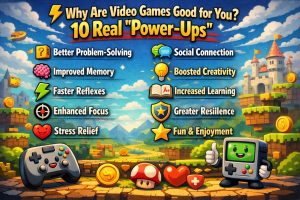
⚡ Why Are Video Games Good for You? 10 Real “Power-Ups”
Here is where things get exciting. Think of each benefit below as a power-up – a real skill or strength your child is quietly building every time they play the right game. Why are video games good for you? These 10 reasons tell the full story.
🧠 Power-Up 1: Brain Workout (Focus and Memory)
Every time a player remembers a map layout, tracks multiple enemies, or plans several moves, they are giving their brain a genuine workout. Strategy and puzzle games in particular demand sustained attention, pattern recognition, and working memory – skills that transfer directly into the classroom.
Best game types: Puzzle games, strategy games, and turn-based adventures.
🏆 Parent Tip: After a session, ask your child: “What was your plan going into that level?” This simple question turns passive play into active reflection.
🔧 Power-Up 2: Real-World Problem-Solving
Games constantly throw unexpected problems at players – a bridge that needs building, a puzzle with no obvious solution, or a resource that runs out at the worst moment. Kids who game regularly learn to think laterally, test multiple solutions, and adapt quickly when the first approach fails.
Best game types: Logic games, simulation games, and building games.
💪 Power-Up 3: Persistence
Every level that defeats a player is also a lesson in resilience. Unlike school tests, where failure feels final, games celebrate the attempt and immediately offer another chance. Over time, kids who game regularly develop a powerful “try again” mindset that carries into real-life challenges.
Best game types: Level-based games with progressive difficulty and meaningful challenges.
🏆 Parent Tip: Praise the effort, not just the win. Say “I love that you kept trying” rather than “Well done for beating it.”
⚡ Power-Up 4: Faster Reactions and Hand–Eye Coordination

Action games require players to respond to fast-moving objects, time their movements precisely, and coordinate what they see with what they do – all in real time. These skills improve reaction speed and hand–eye coordination, which have practical benefits in sports, music, and even surgery (yes, really!).
Best game types: Action games, rhythm games, and timing-based platformers.
🎨 Power-Up 5: Creativity and Imagination
Sandbox and design games hand kids an empty world and say: “Build whatever you can imagine.” The results are often extraordinary – cities, machines, stories, and systems that reflect genuine creative thinking. This kind of open-ended play is one of the most powerful forms of creative development available to young learners today.
Best game types: Sandbox games, design tools, and story-driven creative games.
🤝 Power-Up 6: Teamwork and Communication
Co-operative games require players to divide roles, share information, adapt strategies in real time, and support teammates when things go wrong. These are not just gaming skills – they are life skills. Many kids who struggle socially in person find co-op gaming a surprisingly safe and confidence-building space to practice communication.
Best game types: Co-op missions, team-based strategy games, and collaborative building games.
🏆 Parent Tip: Set a “kind chat only” rule before every co-op session. Model the tone you want to hear, and check in briefly after to ask how the team worked together.
😌 Power-Up 7: Stress Relief
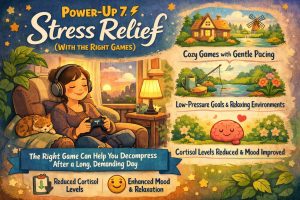
Not all games create stress – in fact, the right game can be a genuinely effective way to decompress after a long, demanding day. Cozy games with gentle pacing, low-pressure goals, and calming environments have been shown to reduce cortisol levels and improve mood meaningfully.
Best game types: Cozy life-simulation games, relaxing puzzle games, and creative design games.
🌟 Power-Up 8: Confidence and Self-Belief
Games are one of the few environments where progress is always visible. Skill trees grow, quests get completed, levels get unlocked, and characters become stronger. This visible, tangible sense of progress builds genuine self-belief – especially in children who struggle to see their growth in academic settings.
Best game types: Role-playing games, quest-based adventures, and games with skill progression systems.
🔬 Power-Up 9: Learning and Curiosity (Especially STEM)
Strategy and simulation games quietly teach economics, physics, engineering, and systems thinking – often without players realizing they are learning at all. Many children who engage deeply with building or simulation games develop a natural curiosity about how real-world systems work, which often translates into a strong interest in STEM Education.
Best game types: Building games, strategy games, and science-themed simulations.
👥 Power-Up 10: Social Connection
For many kids – especially introverts or those who have moved to a new area – gaming is a genuine social lifeline. Playing with known friends and family members online builds and maintains real relationships. Shared gaming experiences create common ground, inside jokes, and lasting memories just as effectively as shared physical activities.
Best game types: Co-op games played with real-life friends and family members.
🎯 Pick a Game for the Benefit You Want
Not sure which game type to choose? Use this table as your personal game menu. Parents, this one is worth screenshotting – it makes the next conversation about screen time significantly easier.
A quick note before the table: always check age ratings before choosing a game for your child. The benefits below apply most effectively when the game content is appropriate for your child’s age and maturity level.
| If You Want… | Try Games Like… | Why It Helps |
| Focus and memory | Puzzle games, strategy games | Planning and sustained attention |
| Creativity | Sandbox games, design tools | Building and open-ended imagination |
| Physical movement | Active games, exergames | Body coordination and energy release |
| Calm and stress relief | Cozy life-simulation games | Gentle pacing and low-pressure goals |
| Teamwork skills | Co-operative mission games | Communication and shared problem-solving |
| STEM curiosity | Building and simulation games | Systems thinking and applied logic |
| Confidence | Quest-based and skill-progression games | Visible progress and achievable challenges |
Turn Play Into Learning (The 5-Minute Post-Game Chat)
This is one of the most practical and underused tools available to parents. A simple five-minute conversation after a gaming session can transform passive entertainment into intentional learning – without feeling like a debrief or an interrogation.
The trick is to ask questions that are genuinely curious, not evaluative. Here are four that work beautifully:
4 Questions to Ask After Every Gaming Session
| Question | What It Develops |
| What was your goal in that session? | Intentional thinking and self-awareness |
| What strategy worked best for you today? | Reflective thinking and planning |
| What did you change after something failed? | Resilience and adaptive problem-solving |
| What will you try differently next time? | Forward thinking and a growth mindset |
💡 Fun Fact: Research from the University of Rochester found that action video game players make decisions up to 25% faster than non-gamers — without sacrificing accuracy. The post-game chat makes that thinking visible and transferable!
⏱️ Are Video Games Good for You Every Day? Healthy Limits That Work
So, does all of this mean kids should play as much as possible? Not quite. Are video games good for you daily? Yes – but with thoughtful boundaries that protect sleep, mood, schoolwork, and physical activity.
The goal is not restriction for its own sake; it is building a routine that lets gaming be genuinely enjoyable and genuinely beneficial.
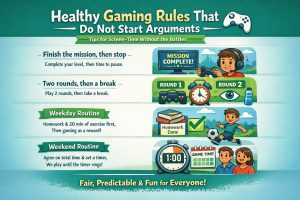
🟢 Healthy Gaming Rules That Do Not Start Arguments
The secret to screen-time rules that actually stick is making them feel fair and predictable rather than arbitrary. Here are a few that work well in practice:
- “Finish the mission, then stop” – This respects natural stopping points in games and reduces the frustration of mid-session cutoffs.
- “Two rounds, then a break” – Short, structured breaks protect both eyes and mood.
- Weekday routine: Homework and at least 20 minutes of physical movement come first. Gaming is the reward, not the default.
- Weekend routine: Agree on a total time in advance, set a visible timer, and stick to it together.
🏆 Pro Tip for Parents: Let your child help set the rules. Kids who co-create boundaries are significantly more likely to respect them — and far less likely to push back when the timer goes off.
🚦 Green Flags vs. Red Flags
Use this quick checklist to check in on your child’s gaming habits weekly:
| 🟢 Green Flags (Healthy Gaming) | 🔴 Red Flags (Time to Reassess) |
| Good mood after playing | Irritability or anger when gaming ends |
| Stable, consistent sleep | Staying up late or having difficulty sleeping |
| Still interested in other activities | Refusing to do anything else |
| Open to stopping when asked | Constant conflict over screen time |
| Talking about what they built or learned | Unable to describe what they played |
🔒Safety Mini Checklist for Parents
Gaming is overwhelmingly safe when the right boundaries are in place. Here is a fast five-point checklist to review today:
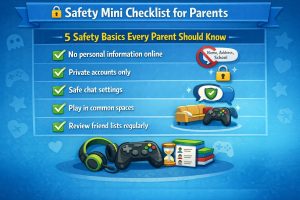
5 Safety Basics Every Parent Should Know
- No personal information online – real name, school, location, and age should never be shared in-game or in chat
- Private accounts only – review privacy settings on every platform your child uses
- Safe chat settings – enable filtered or moderated chat wherever available, especially for younger players
- Play in common spaces – keeping gaming in shared family areas makes supervision natural and comfortable
- Review friend lists regularly – online friends should be people your child knows in real life, especially under the age of thirteen
🚀 From Player to Creator
Here is a thought worth sitting with: if your child loves playing games, imagine how much they would love building one.
The skills that make a great gamer – logical thinking, creative problem-solving, persistence, and attention to detail – are exactly the skills that make a great game creator. And the jump from player to creator is not as big as most parents think.
The progression looks like this:
A Simple Progression Path
| Stage | What It Looks Like | Tools to Try |
| Player | Enjoying and analyzing games | Any game they love |
| Designer | Sketching rules, levels, and characters on paper | Notebook and imagination |
| Builder | Coding a simple playable game from scratch | Scratch, Tynker, Code.org |
| Creator | Sharing a finished game with the world | Scratch community, Codingal projects |
🎯 Challenge for Kids: Pick your favorite game and write down three rules that make it fun. Then ask yourself: “Could I build a simpler version of this?” The answer is almost always yes — and that realization is where real coding journeys begin.
Final Thoughts
So, are video games good for you? The answer – when approached with intention, balance, and the right game choices – is a clear and confident yes. Gaming at its best builds focus, resilience, creativity, teamwork, and genuine self-belief.
It connects kids with friends, sparks curiosity about how the world works, and gives young learners a space to fail safely, try again fearlessly, and succeed on their own terms.
The goal was never to choose between gaming and growing — it was always to do both at the same time. Choose the right games, keep the limits kind and consistent, and watch what your child becomes.
🎮 Ready to Take the Next Step?
If your child loves games, help them become a creator too. Free trial classes and let your child build a beginner-friendly game while learning real coding logic step by step — with a live expert teacher by their side every step of the way.
Frequently Asked Questions
- Are video games good for you?
Yes, when the game type is appropriate and time is balanced, video games offer real benefits, including improved focus, problem-solving skills, creativity, resilience, and social connection. The key is intentional game choice and healthy daily limits rather than unlimited or completely restricted screen time. - Why are video games good for you?
Why are video games good for you comes down to active mental engagement. Unlike passive screen time such as watching television, gaming requires players to make decisions, solve problems, adapt strategies, and interact with others — all of which develop genuine cognitive and social skills over time. - Are video games good for kids’ brains?
Research consistently shows that age-appropriate games can improve working memory, attention span, spatial reasoning, and processing speed in children. Strategy and puzzle games in particular offer measurable cognitive benefits, especially when gaming is balanced with physical activity, sleep, and other enriching activities.
How many hours of video games is healthy?
Most child development experts suggest one to two hours on school days and up to three hours on weekends as a reasonable guideline for children aged six and above. However, quality and game type matter as much as quantity — two hours of creative building is very different from two hours of highly competitive, stressful gameplay. - Do video games reduce stress or increase it?
It depends almost entirely on the game type. Cozy, low-pressure games with gentle pacing genuinely reduce stress and improve mood. High-pressure competitive games can increase cortisol and frustration, especially if the social environment is toxic. Matching the game to the mood is the most effective approach. - Which video games are best for learning?
Building and simulation games develop STEM thinking, strategy games build planning and resource management skills, puzzle games sharpen logical reasoning, and story-driven games strengthen empathy and creative thinking. The best learning games are the ones your child is genuinely motivated to play. - Can video games improve problem-solving?
Yes, significantly. Games constantly present players with novel problems that have no single correct solution, requiring experimentation, adaptation, and persistence. These are precisely the problem-solving habits that transfer into academic and real-world challenges — particularly in STEM subjects. - What are the signs my child is gaming too much?
Key red flags include difficulty stopping when asked, irritability or anger after gaming ends, declining school performance, disrupted sleep patterns, loss of interest in previously enjoyed activities, and withdrawal from in-person social interaction. If three or more of these appear consistently, it is worth reviewing the gaming routine calmly and openly. - Are video games good for social skills?
Co-operative games played with known friends and family members are genuinely effective at building communication, teamwork, and empathy. Online play with strangers carries more risk, particularly for younger children. Supervised co-op gaming in a positive social environment is one of the most beneficial types of screen time available. - How can I make gaming more educational at home?
Use the five-minute post-game chat — ask what your child learned, what strategy worked, and what they would try differently next time. Choose game types that match learning goals: building for STEM, story games for literacy, and strategy for planning skills. And whenever possible, play alongside your child — shared gaming is one of the most effective ways to make it both educational and memorable. - Are video games good for you if you play every day?
Yes—video games can still be good for you if you play daily, as long as the time is balanced with sleep, movement, school/work, and offline time. Choose age-appropriate games, take breaks, and keep gaming from replacing healthy routines.