Table of Contents
What Does STEM Education Mean? Where Does Coding Fit Into STEM? Why Coding Is a Core STEM Skill Examples of Coding Activities in STEM Classrooms Is Coding Mandatory in STEM Education? STEM Without Coding vs. STEM With Coding At What Age Should Kids Start Coding in STEM? Conclusion Help Your Child Experience Real STEM Education Frequently Asked Questions
Coding is often discussed among parents because it is closely linked to STEM education. This is especially true today, as robotics, artificial intelligence, and digital learning are becoming more common in schools. As a result, many parents are asking whether coding is an essential part of STEM education.
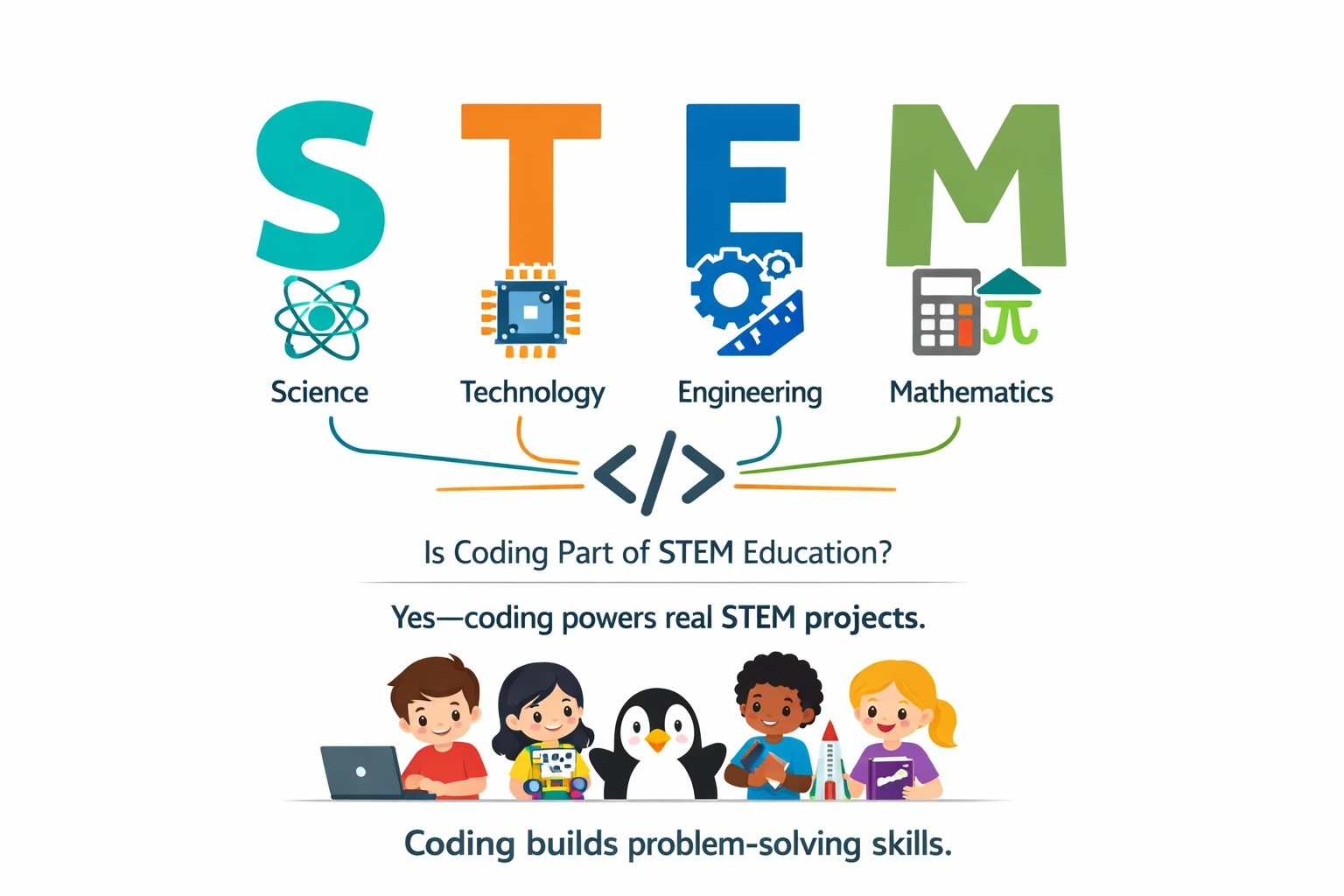
In order to properly answer this question, it is important to first understand what STEM education actually means. The acronym STEM refers to the four disciplines of Science, Technology, Engineering, and Mathematics. It represents an integrated approach to education that encourages students to build problem-solving abilities and develop innovative solutions.
The answer to the question “Is coding part of STEM education?” is clearly yes. Coding is not simply an activity done for fun or as a hobby; rather, coding provides a foundation for how students apply both science and mathematics in their lives to solve real-life problems.
In this article, we will explore how coding relates to each area of STEM education and provide examples of how students can use coding to strengthen their understanding of all four STEM disciplines. If you are looking for structured coding programs for your child, this article will give you the information you need to make a confident choice.
What Does STEM Education Mean?
STEM education means more than learning four subjects separately. It represents an integrated approach to teaching:
- Science – understanding how the world works
- Technology – using tools and systems to solve problems
- Engineering – designing and building solutions
- Mathematics – analyzing patterns and numbers
Instead of teaching these in isolation, STEM education connects them through projects and hands-on learning. For example, students might use math to design a bridge, science to test its strength, engineering to improve it, and technology to simulate it.
If you want a deeper explanation, you can also read our guide on “What Does STEM Mean in School?”
Where Does Coding Fit Into STEM?
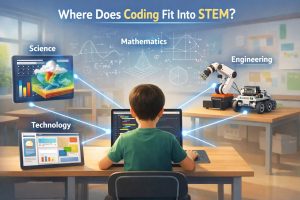
Coding connects all four pillars of STEM , making it a cross-functional skill that strengthens every discipline.
1. Coding and Technology
Coding powers apps, websites, games, artificial intelligence systems, and digital platforms. Whenever students build a website or create a mobile app, they are applying technology through programming.
2. Coding and Engineering
Engineering is about designing and building solutions. Coding helps students program robots, create simulations, and automate processes. For example, robotics competitions often require coding to control movements and sensors.
3. Coding and Mathematics
Mathematics is deeply embedded in coding. Algorithms, logical sequences, variables, and data structures all rely on mathematical thinking. Writing a program teaches pattern recognition and structured reasoning.
4. Coding and Science
Modern science depends heavily on coding. Researchers use programming to analyze data, model climate systems, simulate experiments, and process large datasets. Even basic school science projects now include digital simulations.
This shows clearly that coding is not separate from STEM education — it strengthens every part of it.
Why Coding Is a Core STEM Skill
Coding supports the main goals of STEM education by developing:
- Logical reasoning
- Structured problem-solving
- Creativity through digital creation
- Computational thinking
- Adaptability in a technology-driven world
According to global workforce trends, technology-related jobs continue to grow rapidly. Skills like programming and data analysis are increasingly required across industries — not just in software companies but in healthcare, finance, engineering, and research.
When students learn coding early, they build confidence in tackling complex problems.
Examples of Coding Activities in STEM Classrooms
Here are practical ways coding appears in STEM classrooms:
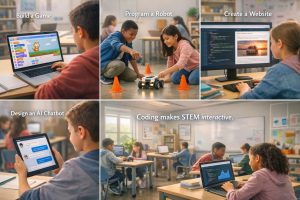
- Building a simple game in Scratch to understand logic
- Programming a robot to navigate obstacles
- Creating a website as part of a design project
- Designing an AI chatbot to simulate conversations
- Solving math puzzles using Python
These projects combine creativity with structured thinking, making STEM education more interactive rather than purely theoretical.
Is Coding Mandatory in STEM Education?
Coding is not always mandatory in every school system. However, it is increasingly integrated worldwide. Many countries now introduce coding at the elementary level as part of digital literacy or computer science programs.
Even when coding is not formally required, it is becoming a foundational skill. As industries move toward automation and AI-driven systems, programming knowledge provides students with a strong academic and career advantage.

STEM Without Coding vs. STEM With Coding
| STEM Without Coding | STEM With Coding |
| Theory-heavy lessons | Interactive projects |
| Limited automation | Real-world digital tools |
| Passive learning | Active creation and experimentation |
| Textbook-focused | Hands-on problem-solving |
Coding transforms STEM from theoretical understanding into practical application.
At What Age Should Kids Start Coding in STEM?
Coding can be introduced at different stages of a child’s STEM education journey:
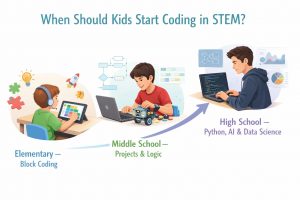
- Elementary school – Block-based coding platforms that focus on logic and creativity
- Middle school – Project-based learning with structured programming concepts
- High school – Advanced languages like Python, AI applications, robotics, and data science
Starting early helps students build confidence gradually. Many parents explore coding classes for kids or structured AI courses for students to support this journey.
Conclusion
So, is coding part of STEM education? Absolutely. Coding is not just an add-on skill – it is a powerful tool that connects science, technology, engineering, and mathematics in meaningful ways.
As education continues to evolve, coding strengthens students’ ability to think critically, solve problems creatively, and prepare for a future shaped by innovation. Whether your child wants to build games, design apps, or explore artificial intelligence, coding forms the backbone of modern STEM learning.
Help Your Child Experience Real STEM Education
Hands-on coding projects help students move beyond theory and start building real solutions. With Codingal’s live, teacher-led classes, your child learns STEM through fun, guided projects – like games, apps, and beginner AI activities – designed to build logic, creativity, and problem-solving skills.
Book a free 1:1 coding trial class to see how coding fits naturally into STEM education and how your child learns in a supportive, structured environment.
Frequently Asked Questions
- Is coding part of STEM education?
Yes, coding is a core part of STEM education because it supports technology, engineering design, mathematical logic, and scientific data analysis. It connects all four STEM components in practical ways. - Why is coding important in STEM?
Coding builds logical thinking, computational skills, and creativity. It allows students to apply science and math concepts to real-world digital solutions, making STEM education more interactive. - Is coding considered engineering?
Coding supports engineering but is not identical to it. Engineering focuses on designing solutions, while coding helps implement and automate those designs through software and systems. - What STEM subjects use coding?
Science uses coding for data analysis, mathematics uses it for algorithms and modeling, engineering uses it in robotics and automation, and technology relies on it to build apps and systems. - Can kids learn coding as part of STEM?
Yes, children can begin coding through age-appropriate platforms as early as elementary school. Many STEM programs now integrate coding into their curriculum to build foundational digital skills. - Is coding considered a STEM subject?
Coding is not a separate STEM subject like science or mathematics, but it is a core skill within STEM education. It supports technology and engineering directly, while also strengthening the logical thinking used in math and science. This is why coding is widely integrated into modern STEM programs in schools. - Why do schools include coding in STEM programs?
Schools include coding in STEM programs because it helps students apply concepts practically. Instead of only learning theory, students use coding to build apps, run experiments, and solve problems digitally. This makes STEM education more interactive, engaging, and aligned with real-world technological advancements. - Does STEM education always include computer science?
Not all STEM programs formally include computer science, but many now do. Computer science, which includes coding, strengthens the technology and engineering components of STEM. As digital skills become more essential, schools increasingly integrate coding to make STEM education more future-ready and relevant. - How does coding improve problem-solving in STEM?
Coding teaches students to break complex problems into smaller steps, identify patterns, and test solutions logically. These skills are essential in science experiments, engineering design, and mathematical reasoning. By debugging programs, students learn resilience and analytical thinking — both central goals of STEM education. - Is coding important for non-technical careers in STEM?
Yes, coding is increasingly valuable even in non-technical STEM careers. Scientists use programming for data analysis, engineers automate systems, and researchers model simulations. Basic coding knowledge enhances efficiency and innovation, making it a useful skill across many STEM-related professions.