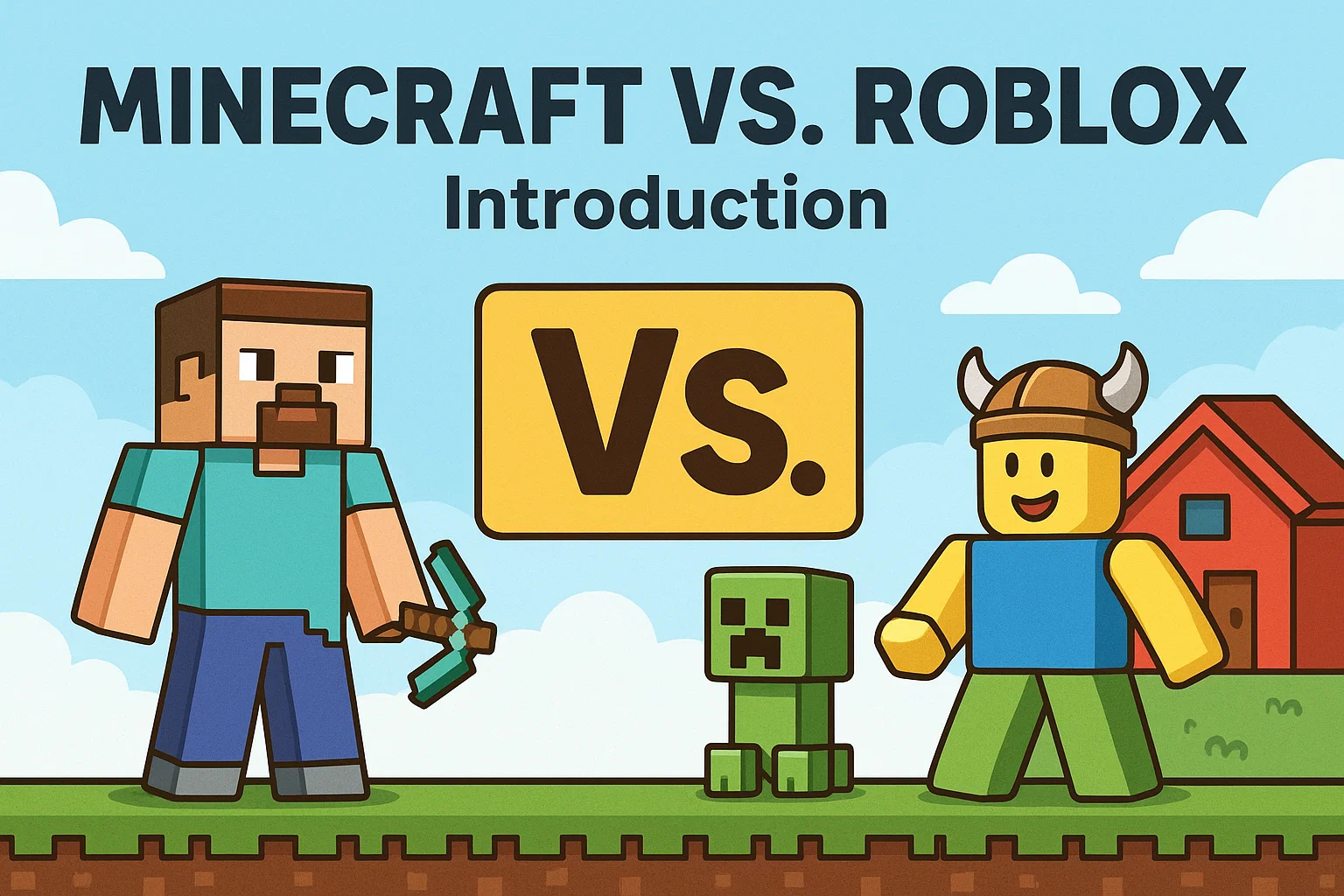
Minecraft Vs. Roblox: Introduction
For over a decade, two blocky behemoths have dominated the creative gaming landscape: Minecraft and Roblox. Both platforms boast hundreds of millions of players, a distinctive, block-based aesthetic, and a core philosophy centered on creativity and community. To the casual observer, they might seem interchangeable, two sides of the same pixelated coin. However, beneath the surface of their shared visual style, Minecraft and Roblox are fundamentally different entities, offering distinct experiences, business models, and creative toolkits. Understanding these differences is key to appreciating the unique value each brings to the world of digital entertainment and creation.
Core Identity: A Game vs. A Platform
The most crucial distinction between the two lies in their core identity. Minecraft is, at its heart, a single, cohesive game. It is a massive, open-world sandbox focused on exploration, survival, and building. Every player enters the same world with the same rules, the same mobs, and the same goal: to survive, explore, and eventually defeat the Ender Dragon. While the game offers immense creative freedom, the experience is unified and consistent, driven by the core mechanics established by its developer, Mojang Studios 1.
In stark contrast, Roblox is not a game; it is a massive user-generated content (UGC) platform. It is a digital ecosystem that hosts millions of distinct “Experiences” (games) created entirely by its community of developers. When a player logs into Roblox, they are not entering a single world but a portal to an infinite variety of worlds, ranging from role-playing adventures like Adopt Me! to intense combat games and intricate obstacle courses (Obbys). The experience is fragmented, diverse, and constantly evolving, driven by the creativity of millions of independent creators 2.
Gameplay and Experience: Consistency vs. Variety
The difference in identity translates directly into the gameplay experience. Minecraft offers a deep, structured gameplay loop. Players spend their time mining for resources, crafting tools and armor, building intricate structures, and mastering complex systems like Redstone engineering, which allows for the creation of in-game logic gates and automated machines. The game’s iconic, low-fidelity, block-based graphics are part of its charm, providing a consistent, nostalgic aesthetic that has remained largely unchanged since its inception. This consistency allows players to become masters of a single, rich environment.
Roblox, conversely, is defined by its infinite variety. A player’s experience on Roblox is entirely dependent on the “Experience” they choose. One moment, they might be running a virtual pizza parlor; the next, they could be competing in a fast-paced racing game or exploring a horror-themed escape room. The graphics on Roblox are also more varied and have evolved to be more complex than Minecraft’s, often featuring smoother textures, more detailed models, and a wider range of artistic styles, though still maintaining a stylized, often blocky, appearance. The trade-off for this variety is a less predictable experience, as the quality and safety of games can vary widely.
| Feature | Minecraft | Roblox |
| Core Identity | A single, cohesive sandbox game. | A platform hosting millions of user-created games. |
| Primary Focus | Exploration, Survival, Building, Redstone Engineering. | Social Interaction, Playing diverse “Experiences.” |
| Graphics | Iconic, consistent, low-fidelity 1×1 block aesthetic. | Varied, stylized, often smoother and more complex models. |
| Multiplayer | Persistent, long-term servers (Realms). Collaborative world-building. | Session-based, instant join/leave. Focus on short-term social play. |
| Monetization | One-time purchase, Marketplace, Realms subscription. | Free-to-play, in-game purchases using Robux (UGC economy). |
The Creator’s Toolkit and Educational Value
Both platforms are celebrated for their educational value, but they teach different skills. Minecraft is an excellent tool for teaching spatial reasoning, resource management, and basic logic. Its creation tools are intuitive: building is done block-by-block, and Redstone provides a visual, hands-on introduction to circuitry and logic gates. For advanced users, the Java Edition’s modding community offers a pathway into software development and game design principles.
Roblox offers a much steeper, but ultimately more powerful, learning curve for aspiring developers. Its creation suite, Roblox Studio, is a professional-grade development environment. Creators use the Lua scripting language to build and program their games. This process is less about stacking blocks and more about actual software engineering, making Roblox a superior platform for learning practical, transferable coding skills and understanding the economics of game development 3
. The platform empowers creators to become entrepreneurs, building and monetizing their own virtual businesses.
Community, Multiplayer, and Safety
The multiplayer experience on each platform reflects its core identity. Minecraft’s multiplayer is often characterized by persistence. Players join dedicated servers or private Realms, where they collaborate on long-term projects, build massive cities, and share a sense of ownership over a world that evolves over months or years. The community tends to be focused on the shared goal of the world.
Roblox multiplayer is more session-based. Players jump into an experience, play for a short time, and then move on. Social interaction is immediate and central, often involving role-playing and quick collaboration. Because the content is user-generated and the platform is massive, safety and moderation are constant, complex challenges. Roblox employs a vast system of automated filters and human moderators to police millions of experiences and billions of chat messages, though the sheer volume of content means parents must remain vigilant about the quality and appropriateness of the games their children access 4
. Minecraft, being a contained game, offers more control, especially on private servers.
Monetization and the Creator Economy
The financial models of Minecraft and Roblox are perhaps the most divergent aspect of the comparison. Minecraft operates on a traditional, premium model. The game itself requires a one-time purchase, and additional revenue comes from the official Minecraft Marketplace, where players can buy skins, texture packs, and pre-built worlds, as well as subscriptions to Realms for easy private server hosting. This model is straightforward and predictable.
Roblox pioneered a true creator economy based on the free-to-play model. The platform is free to download and play, but all in-game transactions are conducted using Robux, the platform’s virtual currency. Developers can sell “Game Passes” (permanent perks) and in-game items, earning a share of the Robux spent in their experiences. This system has allowed top Roblox developers to earn substantial real-world income, turning the platform into a powerful engine for digital entrepreneurship 5
.
Conclusion: Which Sandbox Reigns Supreme?
Ultimately, the question of which is “better” is impossible to answer, as it depends entirely on the user’s goals.
Minecraft is the clear choice for the player who values a consistent, deep, and focused sandbox experience. It is the perfect digital playground for survivalists, explorers, and those who want to master the art of block-by-block building and Redstone engineering.
Roblox is the superior choice for the player who craves endless variety, immediate social interaction, and the opportunity to become a game developer. It is a platform, a social network, and a creator economy rolled into one, offering a glimpse into the future of user-generated content.
In the end, both Minecraft and Roblox are titans of creativity, each offering a unique path to digital mastery. The ultimate winner is the player, who gets to choose which sandbox best fits their creative ambition.