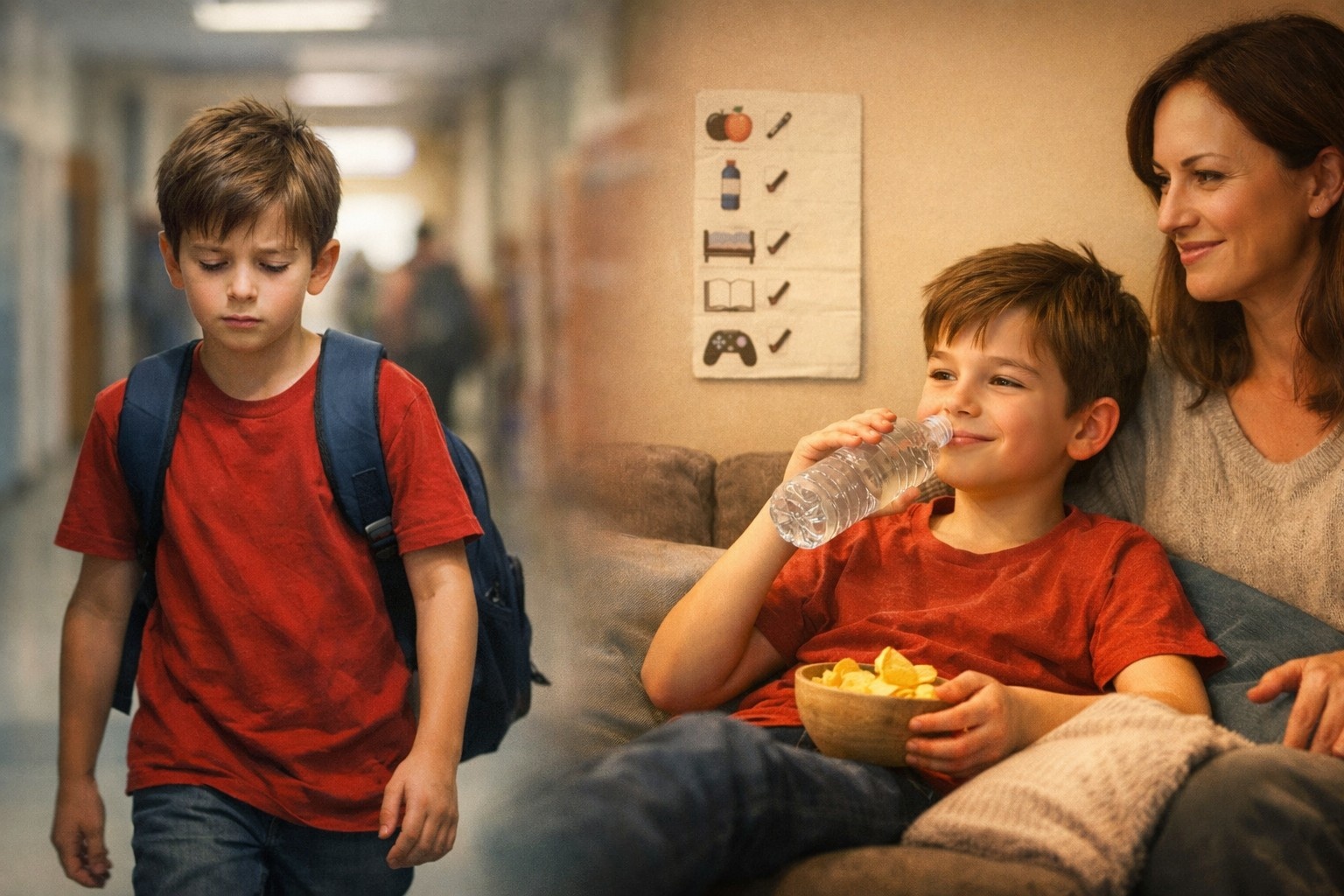
Table of Contents
Why Are Kids So Tired After School? The Quick Answer Mental Exhaustion Physical Activity Lack of Sleep Poor Nutrition Illness The Routine Factor Final Thoughts Could Gaming Be Part of the Solution? Frequently Asked Questions
Does your child walk through the door after school looking like they have just run a marathon – backpack dropped, shoes barely off, completely drained? You are not imagining it, and you are definitely not alone. Why are kids so tired after school is one of the most searched questions among parents today – and the answer is more interesting than you might expect.
In this guide, we will break down the real reasons behind after-school exhaustion, what each one means for your child, and – most importantly – simple, practical routines that actually help. No complicated schedules. No guilt. Just clear answers and easy wins.
💡 Fun Fact: The human brain uses approximately 20% of the body’s total energy – even though it only accounts for about 2% of body weight. After a full school day of concentrating, learning, and socializing, it is no wonder kids come home running on empty!
Why Are Kids So Tired After School? The Quick Answer
Why are kids so tired after school? In short, school is far more demanding than most adults remember. A typical school day asks children to concentrate for hours, navigate complex social situations, manage emotions, sit still for long periods, absorb large amounts of new information, and transition between subjects and environments repeatedly – all before lunchtime.

The after-school exhaustion most children experience is not laziness or a lack of fitness. It is the completely natural result of a genuinely demanding day. The good news is that understanding the specific cause makes it significantly easier to help.
🏆 Pro Tip for Parents: Before assuming your child is being dramatic, try remembering your most mentally demanding workday. Now imagine doing that five days a week at age seven. The exhaustion makes perfect sense.
🧠 Mental Exhaustion (The “Brain Is Full” Effect)
Of all the reasons why kids are so tired after school, mental exhaustion is the most underestimated. Children’s brains are not just learning academic content during the school day – they are simultaneously processing social cues, managing peer relationships, regulating emotions, following instructions from multiple adults, and switching focus dozens of times every single hour.
By the time the final bell rings, many children have genuinely reached their cognitive limit. Neuroscientists call this decision fatigue – the mental depletion that comes from making too many choices and processing too much information over a sustained period.

In children, this shows up not as quiet tiredness but as irritability, emotional outbursts, difficulty making simple decisions, and a desperate need for low-demand downtime.
💡 Fun Fact: Studies show that children make hundreds of micro-decisions every school day – from choosing where to sit to deciding how to respond to a friend. Each one uses real mental energy, just like a muscle that gradually tires with use.
🚨 Signs of Mental Exhaustion in Kids
Watch for these signs in the hour after school:
| Sign | What It Really Means |
| Unusual irritability or meltdowns | The brain’s emotional regulation is depleted |
| Inability to make simple choices | Decision fatigue has set in |
| Crying over small things | Emotional reserves are completely empty |
| Zoning out or staring blankly | The brain is actively seeking rest |
| Refusing to talk about their day | Social energy is fully spent |
| Wanting screen time immediately | Seeking low-demand, passive stimulation |
✅ What Parents Can Do (Fast)
The single most effective thing you can do for a mentally exhausted child is give them unstructured, low-demand time immediately after school. This means no questions, no homework, no activities – just space to decompress on their own terms for 20 to 30 minutes.

Here is a simple post-school decompression menu to try:
- 🎨 Free drawing or coloring with no goal or outcome
- 🧸 Quiet play with a favorite toy or figure
- 📚 Reading a book of their own choice
- 🌿 Sitting outside with a snack and no agenda
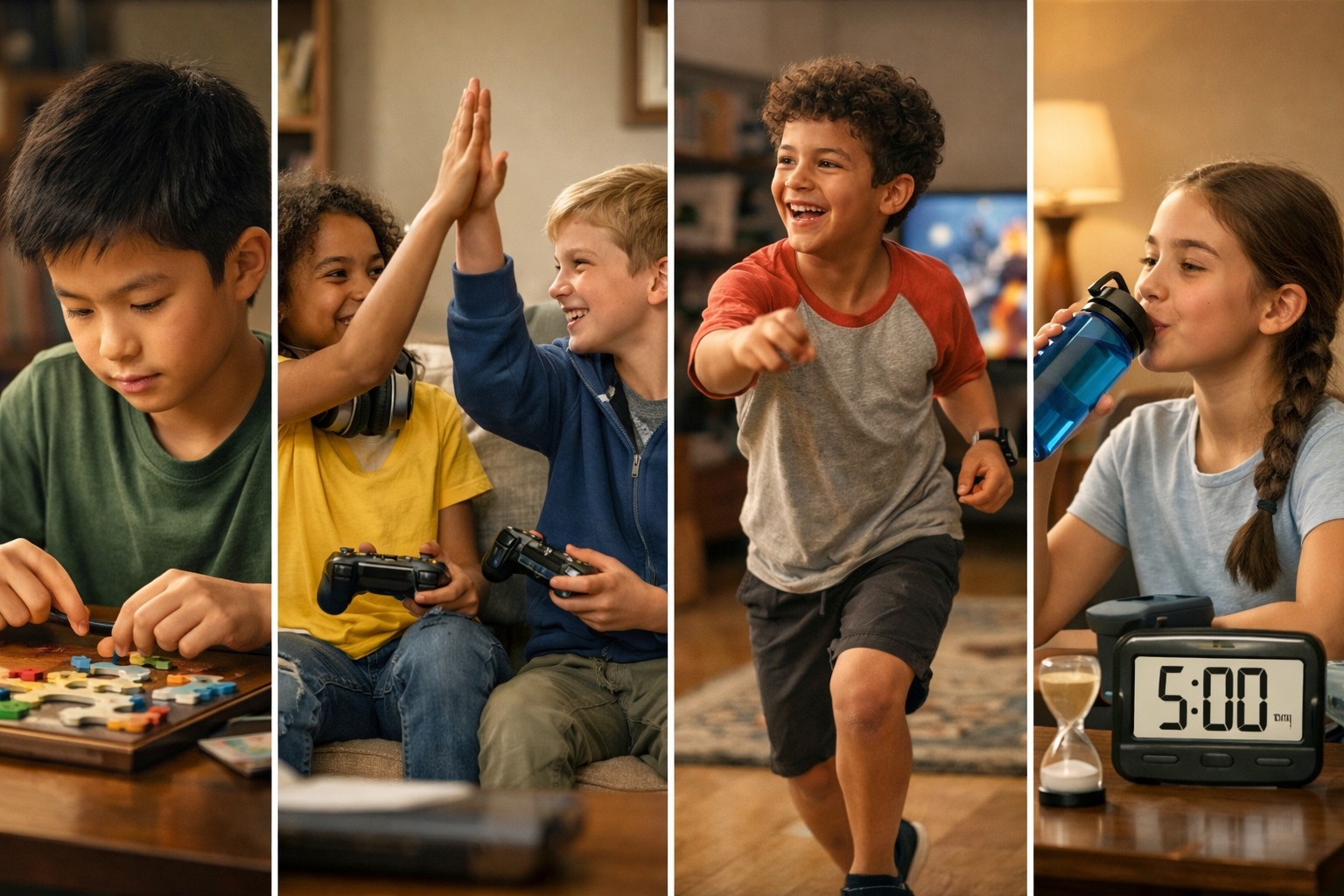
- 🎮 A short, low-pressure game session (cozy games work best)
🏆 Pro Tip: Resist the urge to ask “How was your day?” the moment they walk in. Wait 20 to 30 minutes. The conversation that happens after decompression time is almost always richer, calmer, and more honest than the one forced at the door.
🏃 Physical Activity
Here is a surprising paradox that confuses many parents: children who sit still all day often feel more physically tired than children who move regularly. This is because the human body is not designed for prolonged stillness – and when children are forced to suppress their natural movement urges for hours, it actually creates physical tension and fatigue rather than conserving energy.
At the same time, children who do have physically active school days – with sports, PE, or active breaks – experience a different kind of tiredness: the healthy, satisfying tiredness that comes from genuine physical exertion. Both types of tiredness are real, but they require different responses.
⚡ Quick Energy Reset
If your child seems physically sluggish after school, counter-intuitively the best solution is often more movement, not less. Try these quick energy reset ideas:
| Activity | Time Needed | Energy Effect |
| A 10-minute walk around the block | 10 minutes | Resets mood and circulation |
| Jumping on a trampoline or skipping | 5–10 minutes | Boosts energy and lifts mood quickly |
| Kicking a ball in the garden | 10–15 minutes | Burns tension and restores focus |
| A quick dance to a favorite song | 3–5 minutes | Immediate mood and energy boost |
| Stretching or simple yoga poses | 5–10 minutes | Releases physical tension from sitting |
🎯 Family Challenge: For one week, try a 10-minute outdoor walk together immediately after school before homework or screens. Notice the difference in your child’s mood and focus during homework time. Most families who try this never go back!
😴 Lack of Sleep (The Number One Energy Thief)
If you are asking why are kids so tired after school every single day without obvious explanation, the most likely culprit is insufficient sleep. Sleep is not just rest – it is the period during which children’s brains consolidate the day’s learning, repair tissue, regulate hormones, and prepare for the demands of the following day. Without enough of it, everything suffers.

The problem is that modern children’s sleep is being eroded from multiple directions simultaneously – screens before bed, overscheduled evenings, anxiety about the next day, and bedroom environments that are not optimized for quality sleep.
Here is how much sleep children actually need, according to current guidelines:
| Age Group | Recommended Sleep Per Night |
| Preschool (3–5 years) | 10–13 hours |
| School age (6–12 years) | 9–12 hours |
| Teenagers (13–18 years) | 8–10 hours |
💡 Fun Fact: During deep sleep, the brain’s glymphatic system activates – essentially a biological cleaning process that flushes out toxic waste products accumulated during the day. Without sufficient sleep, this cleaning process is incomplete, leaving children foggy, irritable, and exhausted the following day.
🌙 Simple Sleep Routine That Works
A consistent, calming bedtime routine is the single most evidence-backed solution for improving children’s sleep quality. Here is one that works for most families:
The 4-Step Wind-Down Routine:
| Step | Activity | Time |
| Step 1 | All screens off – no exceptions | 60 minutes before bed |
| Step 2 | Warm bath or shower | 30–45 minutes before bed |
| Step 3 | Calm activity – reading, drawing, or quiet chat | 20–30 minutes before bed |
| Step 4 | Lights out in a cool, dark, quiet room | Consistent time every night |
🏆 Pro Tip: The consistency of bedtime matters more than the exact time. A child who goes to bed at 8:30 PM every night will sleep significantly better than one who goes at 7:30 PM some nights and 10:00 PM others. The body clock thrives on predictability.
🍎 Poor Nutrition (Energy Dips and Sugar Crashes)
What children eat – and when they eat it – has a direct and measurable impact on their energy levels throughout the day. Many children arrive home from school experiencing a blood sugar crash, triggered by a lunch that was either too small, too high in simple sugars, or eaten too early in the day to sustain them through to the afternoon.
The classic signs of a blood sugar crash look almost identical to tiredness: irritability, difficulty concentrating, headaches, and a desperate craving for something sweet. The problem is that reaching for a sugary snack at this point creates a short energy spike followed by an even deeper crash – making the exhaustion worse rather than better.
🥕 After-School Snack Formula
The most effective after-school snack combines three elements: slow-release carbohydrates + protein + healthy fat. This combination stabilizes blood sugar, sustains energy for homework and activities, and keeps hunger at bay until dinner.
| Snack Idea | Why It Works |
| Apple slices with peanut butter | Carbs + protein + healthy fat |
| Wholegrain crackers with cheese | Slow-release energy + protein |
| Greek yoghurt with berries | Protein + natural sugars + antioxidants |
| Boiled egg with wholegrain toast | Complete protein + slow-release carbs |
| Banana with a small handful of nuts | Natural energy + healthy fat + protein |
| Hummus with vegetable sticks | Protein + fiber + slow-release energy |
⚠️ Parent Alert: Avoid sugary snacks, fizzy drinks, and high-sugar fruit juices as the first thing after school. The short energy boost they provide is always followed by a crash that makes tiredness, irritability, and focus problems significantly worse.
🤒 Illness (Or the “Quiet Symptoms”)
Sometimes the reason why kids are so tired after school is simpler and more straightforward than routines or nutrition – they are coming down with something. Children’s immune systems work hard, and the early stages of illness often present as unusual tiredness long before any obvious symptoms like fever or runny nose appear.
This “quiet symptom” phase – where a child seems more tired than usual without any clear explanation – is easy to dismiss as a bad day or a rough week. But if the exhaustion is new, sudden, or noticeably different from your child’s normal tiredness, it is worth paying closer attention.
🩺 When to Take It Seriously
Use this quick reference guide to help distinguish between normal after-school tiredness and tiredness that warrants a closer look:
| Normal After-School Tiredness | Tiredness That Needs Attention |
| Improves after 30 – 60 minutes of rest | Persists through the evening and next morning |
| Better after a good snack | Not improved by food or rest |
| Child is still interested in activities | Complete withdrawal from everything |
| Consistent with a busy school week | Sudden and unexplained change in energy |
| No other physical symptoms | Accompanied by fever, pain, or pallor |
| Resolves after a good night’s sleep | Present for more than a week consistently |
📅 The Routine Factor (Why Structure Helps Tired Kids)
One of the most powerful and underused tools for managing after-school exhaustion is a consistent, predictable daily routine. When children know exactly what to expect after school – snack, downtime, movement, homework, dinner, wind-down – their nervous system can relax into the structure rather than spending energy navigating uncertainty.
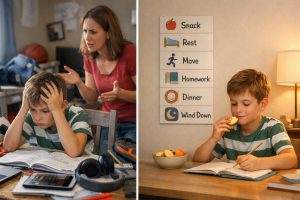
Unpredictable afternoons, where the schedule changes daily and expectations are unclear, are significantly more draining for children than structured ones – even when the structured ones include more activities. Predictability is genuinely restorative for the developing brain.
📋 Sample After-School Routine (Simple)
Here is a practical, flexible routine that works for most primary and middle school children:
| Time | Activity | Why It Helps |
| Arrival home | Shoes off, bag down, free time – no questions | Decompression and nervous system reset |
| 15–20 minutes | Healthy snack | Blood sugar stabilization and energy restoration |
| 20–30 minutes | Unstructured free play or outdoor movement | Physical and mental reset |
| 30–45 minutes | Homework or reading | Brain is refreshed and ready to focus |
| Until dinner | Free choice – creative play, reading, or screen time | Autonomy and genuine relaxation |
| After dinner | Family time, calm activities | Connection and emotional refueling |
| 60 minutes before bed | Wind-down routine begins | Sleep preparation and nervous system calming |
🎯 Challenge for Families: Try this routine for just five school days and notice the difference. Most families report fewer arguments, calmer evenings, and children who are visibly more settled by day three.
Final Thoughts
So, why are kids so tired after school? Because school is genuinely hard work – mentally, physically, emotionally, and socially – in ways that are easy to underestimate from the outside. The exhaustion your child brings home every afternoon is not a problem to fix or a weakness to address.
It is evidence that they showed up, tried hard, and gave their full effort to a demanding day. Your job – and it is a meaningful one – is to give them the right conditions to recover, refuel, and reset. A good snack, some unstructured time, a consistent bedtime, and a predictable afternoon routine are not small things. For a tired child, they are everything.
🎮 Could Gaming Be Part of the Solution?
If your child decompresses after school through gaming, why not channel that passion into something that builds real skills? At Codingal, kids learn to build their own games – developing focus, creativity, and problem-solving skills – all while doing something they already love. Book a free trial classes today and watch your child go from player to proud creator, one step at a time.
Frequently Asked Questions
- Is it normal for kids to be tired after school?
Yes, it’s very normal. School uses a lot of mental energy – listening, learning, socializing, and following rules all day. Add walking, PE, and after-school activities, and many kids crash at home. A short snack-and-rest routine usually helps. - Does starting school earlier really make kids more tired after school?
Yes. In the study of National Library of Medicine, researchers compared two schools (7:00 AM vs 8:00 AM start) and found that students with the earlier start time had shorter sleep duration, more sleep deprivation, higher daytime sleepiness, poorer sleep quality, and worse mood scores (including higher depression scores). - Why are kids so tired after school every day?
Daily tiredness usually comes from a mix of mental load, inconsistent sleep, not eating enough at lunch, dehydration, and busy schedules. Some kids also mask stress or anxiety at school, which drains energy. Track sleep, snacks, and routines for a week to spot patterns. - Why is my 14-year-old so tired after school?
Teens often need more sleep but have earlier school starts, heavier homework, and higher social stress. Puberty shifts their body clock later, so they fall asleep later but still wake early. Check sleep duration, phone use at night, and whether after-school loads are too packed. - Is it okay for my child to nap after school?
Yes – if naps are short and don’t disrupt bedtime. A 20 – 30 minute “power nap” can help mood and focus. Avoid long naps late in the evening, which can make bedtime harder. If your child naps daily for hours, review sleep quality and health factors. - What should kids eat after school to boost energy?
Choose a snack with protein + fiber for steady energy. Examples: yogurt and fruit, peanut butter sandwich, nuts with a banana, cheese and crackers, or eggs. Add water first. Avoid only sugary snacks, which can cause a quick boost followed by a crash. - How long should kids rest after school?
Most kids benefit from 20 – 45 minutes of downtime after school. Keep it calm and low-demand: snack, water, light play, reading, or quiet time. After that, many kids can handle homework or activities better. Highly sensitive kids may need a bit longer. - Does screen time make kids more tired after school?
It can. Some kids feel more drained after fast-paced or loud games/videos, especially right after school when they’re already tired. Screens can also delay homework and bedtime. If screens worsen mood, try a “reset first” rule: snack + break, then screens later. - What is the 9 minute rule for kids?
The “9-minute rule” is a quick reset strategy: give kids about 9 minutes to decompress after school before expecting conversation or tasks. It helps them transition from school mode to home mode. Pair it with water and a snack for better results. - When should I worry about my child being tired after school?
Worry if tiredness is sudden, severe, or lasts more than 2 – 3 weeks. Also watch for sleep problems, frequent headaches, dizziness, weight changes, low mood, or falling grades. If fatigue affects daily life or your child seems unwell, check in with a pediatrician.