Table of Contents
What is Black History Month? Black History Month + STEM: Why this combo works for kids Black History Month STEM Mission Board 16 Black History Month STEM Activities Quick tips to make Black History Month activities more fun Conclusion FAQs
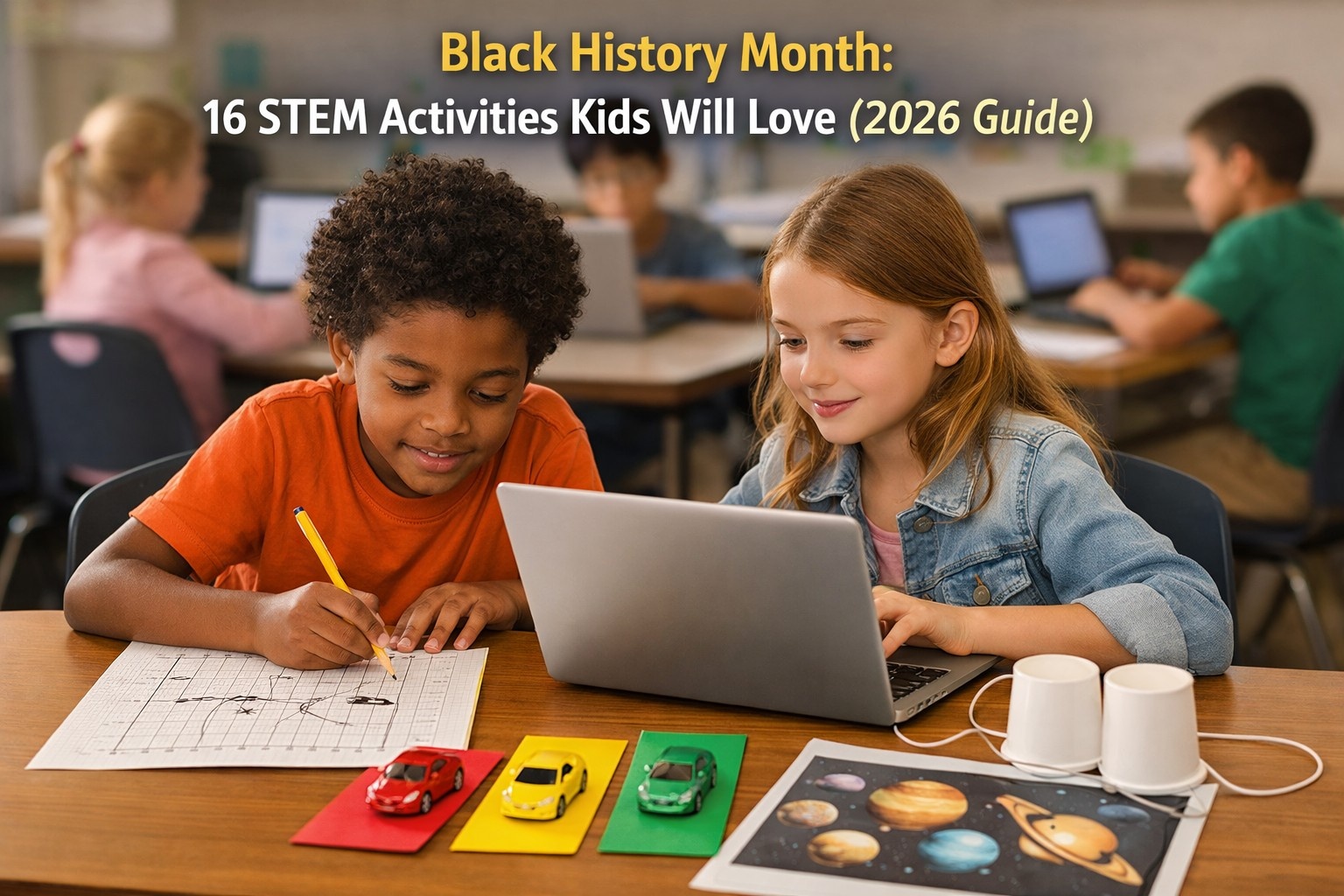
Black History Month is a meaningful time to celebrate stories of courage, creativity, and change – and STEM makes those stories come alive. If you are wondering what Black History Month is, it is a month dedicated to honoring the achievements and contributions of Black leaders across history and today.
In this guide, you will find sixteen fun, hands-on Black History Month STEM activities that kids can try at home or in the classroom. Each idea is simple, engaging, and designed to spark curiosity through building, experimenting, designing, and exploring. Pick one Black History Month activity – or turn it into a weekly challenge.
What is Black History Month?
If you are asking what Black History Month is, think of it as a month-long spotlight on Black history, culture, and contributions. Black History Month helps kids learn about important people and moments that shaped the world we live in today.
It is also a chance to talk about fairness, creativity, and leadership in age-appropriate ways. And when we pair Black History Month with STEM, kids do not just read – they build, test, and explore.

Black History Month + STEM: Why this subject works for kids
Black History Month and STEM go hand in hand because kids learn best by doing, not just listening. Many everyday inventions connect to real Black History Month stories and real people, which makes learning feel meaningful and personal.
Hands-on Black History Month activities also work well for different learning styles – builders, artists, explorers, and puzzle lovers. Most importantly, kids walk away with one powerful feeling: “I made something, and I learned something.”
Black History Month STEM Mission Board
One of the most exciting ways to explore Black History Month is through a STEM Mission Board. Pick one activity like a mission: Explorer, Builder, Scientist, Creator, or Space Cadet. Most Black History Month challenges take 15–30 minutes and use simple home or classroom supplies.

Kids can earn points or badges for each Black History Month mission they complete, which keeps learning fun and motivating. End every mission with one line: “Today I learned…” to make the learning stick.
Choose Your Mission (quick picker)
| Choose your mission | Start with |
| 🧭 Explorer (research + maps) | Scavenger Hunt, Civil Rights Trail, GPS Treasure Hunt |
| 🔧 Builder (hands-on engineering) | Microphone Build, Build Like Mark Dean, Traffic Light System |
| 🧪 Scientist (experiments + testing) | Carver Mini Lab, Percy Julian Kitchen Science |
| 🎨 Creator (art + imagination) | Adinkra Symbols, Harlem Renaissance Poster, Afrofuturism Poster |
| 🚀 Space Cadet (space + missions) | Space Challenge, Mae Jemison Mission Kit |
💰Bonus: Earn five points per Black History Month mission and two bonus points if your child can explain why it worked.
16 Black History Month STEM Activities
Here are sixteen hands-on Black History Month STEM activities designed to inspire curiosity, creativity, and confidence in kids of all ages.
1. Black History Month Online Scavenger Hunt
Pick a few kid-safe pages and turn learning into a clue hunt. Kids search for words like “first,” “invented,” and “changed the world,” then score points for each one they find.

2. George Washington Carver Mini Lab + Craft
Do a simple plant and soil observation and record results like a scientist. Add a quick lab page where kids draw what they saw and write one sentence about what they learned.

3. 3D Print or Draw Adinkra Symbols (Patterns + Geometry)
Explore Adinkra symbols through symmetry, shapes, and repeating patterns. Kids can draw on grid paper or create a patterned border as a design challenge.
4. Build a Microphone Like Dr. James West (Sound Science)
Try a sound and vibration demonstration using safe household materials such as cups, paper, and string. Test two versions and decide which one works better – just like young engineers would.
5. Take a Virtual Tour of the Harlem Renaissance Era
Explore art, music, and creative innovation using a virtual tour or image set. Kids create a museum poster featuring one artist or idea they discovered during the tour.
6. Unlock Space Curiosity With Neil deGrasse Tyson (Space Challenge)
Watch a short space clip, then do a planet size or distance comparison activity. Make it a game: guess first, reveal the answer, and then explain the surprising result.
7. Safe Kitchen Science Inspired by Percy Julian
Do a simple, safe experiment – such as mixing, separating, and observing change — with adult supervision. Kids predict the outcome, test it, and then adjust one variable to observe what happens.
8. Black Scientists Podcast Pick + “Inventor Card” Activity

Listen to a short podcast segment and write three facts and one invention on a card. Trade cards with family members or classmates, or create a mini Hall of Fame display on the wall.
9. Virtually Explore the Alabama Civil Rights Trail (Maps + Distance)
Use a map to connect places, routes, and distances in a kid-friendly way. Kids plan a route and estimate travel time using simple math.
10. Build Like Mark Dean (How Computers Work – Kid Version)
Make a paper model showing the steps of input, process, and output using everyday examples. Act out a program using if-then rules and fun commands to bring the concept to life.
11. Bioethics Discussion (Age-Appropriate) + Science Impact (Henrietta Lacks)
Talk simply about permission, fairness, and how science helps people. Use Yes, No, and Maybe cards so kids can share short reasons and opinions respectfully.
12. “Green Light” Traffic System Activity (Garrett Morgan)
Build a mini traffic system using colored paper and cards alongside toy cars. Challenge kids to create rules that reduce accidents and improve safety.
13. Holograms + Afrofuturism (Science Meets Imagination)
Try a simple light and reflection demonstration, then imagine future technology through creative design. Kids create an invention poster with three features and one problem it solves.
14. Meet Dr. Mae Jemison: Space Mission Engineering Challenge
Kids pack a mission kit using only 5 items and explain each choice. Change the mission (moon, desert, underwater) and redesign the kit.
15. Watch and Discuss Hidden Figures (Teamwork + Math Prompts)

Watch a short clip and discuss teamwork, problem-solving, and persistence. Add 2–3 mini puzzles (patterns, logic, quick math) to make it interactive.
16. Track GPS Technology (Gladys West) With a Coordinate Treasure Hunt
Explain GPS in simple terms: satellites and math help us find locations anywhere in the world. Play a coordinate treasure hunt on graph paper using clues and plotted points.
Quick tips to make Black History Month activities more fun
Getting the most out of Black History Month means keeping activities playful and engaging. Keep it game-like: set a timer and call it a ten-minute Black History Month mission. Let kids guess first, then test – predictions make Black History Month activities far more exciting.
Use achievement badges such as “Explorer,” “Builder,” and “Scientist” to keep motivation high throughout the month. End every session with one line: “Today I learned…” so kids remember the key takeaway.

Conclusion
Black History Month is a meaningful opportunity to learn, celebrate, and spark curiosity in kids. If you have been wondering what Black History Month is, these sixteen STEM activities make the answer feel real through building, experimenting, and exploring.
Start small – choose one activity based on your child’s interest and try it this week. With a few fun projects, kids can experience Black History Month in a way they will actually remember – and carry with them long after the month is over.
Want your child to keep building and exploring beyond Black History Month?
Free Python Class where kids learn through hands-on projects, games, and beginner-friendly coding activities.
FAQs
- What is Black History Month, and why is it celebrated?
Black History Month is a time to recognize and celebrate Black history, achievements, and contributions. It helps kids learn about leaders who shaped culture, science, and society. Families and schools use this month to learn, reflect, and celebrate together. - When is Black History Month in the USA?
In the United States, Black History Month is observed in February each year. Many schools and families plan learning activities throughout the month, including reading, discussions, and hands-on projects that connect history to real life. - How do you explain Black History Month to kids?
Tell kids it’s a special month to learn about Black leaders, creators, and change-makers. Explain that we celebrate their achievements and learn their stories. Keep it positive, simple, and connected to things kids understand, like inventions and teamwork. - What are easy Black History Month activities for elementary students?
Easy activities include a scavenger hunt, making inventor cards, drawing Adinkra-inspired patterns, building a simple traffic light system, or doing a quick science observation. Choose activities that take 15–30 minutes and use basic home or classroom supplies. - What are some Black History Month STEM activities for classrooms?
Great classroom STEM picks include a mini engineering build, a mapping challenge, a sound experiment, a traffic system activity, or a coordinate treasure hunt. These are hands-on, group-friendly, and easy to run with simple materials and clear roles. - Which Black inventors and scientists should kids learn about?
Kids can learn about innovators linked to everyday life, like GPS technology, microphones, computers, and space exploration. You can also introduce scientists and engineers who made breakthroughs in medicine, chemistry, and technology through stories and simple projects. - How can parents celebrate Black History Month at home?
Pick one activity per week, keep it short, and make it fun. Watch a short video, do one hands-on STEM challenge, and end with a quick reflection question. Display your child’s work like a mini “history + STEM showcased.” - What are quick 15-minute Black History Month activities?
Quick ideas include an online scavenger hunt, inventor cards, a mini mapping challenge, a pattern drawing activity, or a “green light” traffic rules game. These work well when you want a low-prep activity with a clear start and finish. - Are there screen-free Black History Month STEM activities?
Yes. Many activities can be screen-free, like building a traffic system, drawing patterns, making mission kits, doing kitchen science (supervised), and creating paper computer models. These are perfect for younger kids or low-screen routines. - How do you connect Black History Month to STEM and coding?
Connect stories to real inventions and then build a mini version of the idea. Coding-style thinking can be added with “if/then” rules, step-by-step instructions, or simple logic games. This keeps learning hands-on and easy to understand.