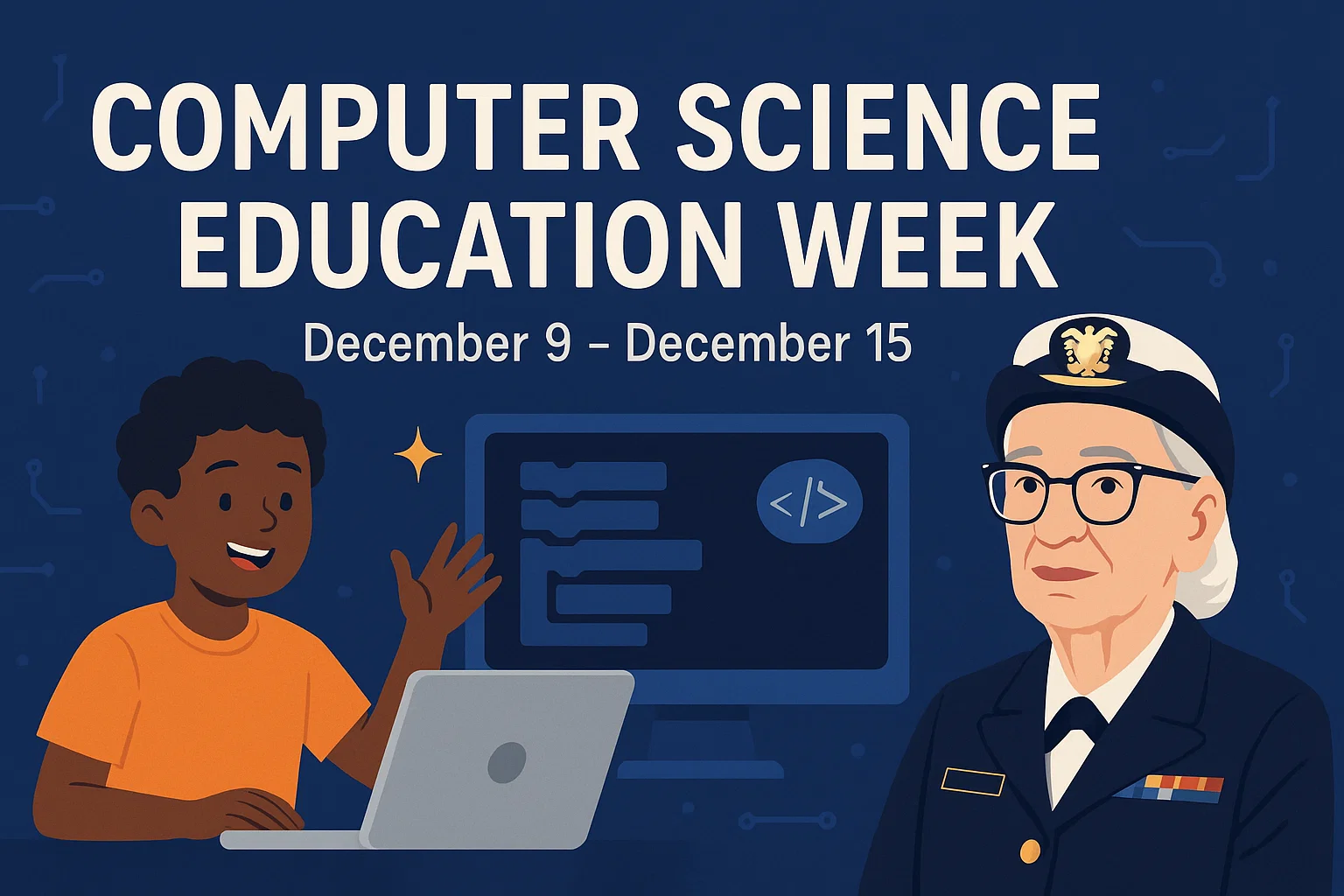
Every December, schools, teachers, and students around the world come together to celebrate Computer Science Education Week (CS Week), a global movement dedicated to making computer science fun, accessible, and inspiring for learners of all ages. This special week reminds us that anyone can learn the basics of technology, build something meaningful, and become part of the digital future.
CS Week is observed during the week of December 9, honoring the birthday of Grace Hopper, one of the greatest pioneers in computing history. Her contributions, including creating one of the first compilers and shaping modern programming by continue to influence the technology we use today.
Let’s dive deeper into what CS Week is, why it matters, and how students, teachers, and families can celebrate it meaningfully.
What Is Computer Science Education Week?
Computer Science Education Week is an annual celebration designed to raise awareness about the importance of computer science. It encourages students to build skills in:
- critical thinking
- problem-solving
- creativity
- collaboration
- digital literacy
While the week shines a spotlight on computer science, its message goes beyond coding—it reminds students that they can shape the future by learning how technology works and how to create with it.
Why December 9? Honoring Grace Hopper
CS Week is held during the week of December 9 to honor Grace Hopper, a trailblazing computer scientist and U.S. Navy Rear Admiral. Hopper was a pioneer in programming languages and is often credited with:
- creating one of the first compilers
- helping develop COBOL
- popularizing the term “debugging”
- inspiring future generations of coders
Her vision helped shape modern software development. Celebrating CS Week around her birthday is a tribute to her legacy and her belief that everyone can learn to program.
The Hour of Code: The Heart of CS Week
The most famous part of Computer Science Education Week is the Hour of Code, a global initiative that invites students to try one hour of coding—no experience required.
Launched in 2009 with the support of major tech companies, the Hour of Code has grown into one of the largest learning campaigns in history.
What makes the Hour of Code so impactful?
✔ It’s simple
Activities take just one hour, perfect for beginners.
✔ It’s inclusive
Kids of all backgrounds, ages, and abilities can participate.
✔ It’s fun
Coding puzzles use themes kids love—Minecraft, Star Wars, Frozen, Marvel, and more.
✔ It sparks interest
A single hour often inspires students to explore coding further.
Millions of students around the world participate every year through schools, libraries, coding clubs, and online platforms.
How CS Week Has Grown Into a Global Movement
When CS Week launched in 2009, the goal was to create opportunities for students to explore computer science. With the support of educators, parents, volunteers, and tech companies, it quickly became a worldwide celebration.
Today, CS Week includes:
- classroom coding lessons
- robotics demonstrations
- STEM workshops
- panel discussions
- teacher training sessions
- coding competitions
- school assemblies
- community tech fairs
From kindergarten classrooms to high school labs, the excitement spreads everywhere.
Why Computer Science Education Matters
Computers and technology are part of nearly every job and industry. Understanding how they work empowers students to:
✔ Solve real-world problems
Coding teaches students how to break problems into steps and find creative solutions.
✔ Build future-ready skills
Digital literacy, logic, and analysis are essential for future careers.
✔ Express creativity
Kids use coding to make stories, animations, games, music, and art.
✔ Boost academic performance
Computer science strengthens math, reading, and problem-solving skills.
✔ Explore career opportunities
From robotics to artificial intelligence, the future is filled with exciting possibilities.
CS Week helps students realize that computer science isn’t just for tech experts—it’s for everyone.
Fun Ways Students and Teachers Can Celebrate CS Week
Here are simple, meaningful ways to bring the spirit of CS Week into the classroom or home:
1. Do an Hour of Code Activity by explore tutorials on Code.org, Minecraft, Scratch, or Tynker.
2. Host a classroom coding challenge by create a game, animation, or story in one hour.
3. Build a mini robotics project use LEGO, VEX, Sphero, or simple DIY kits.
4. Learn about Grace Hopper by watch kid-friendly videos or read stories about her achievements.
5. Create a Coding Corner: Set up a small space with puzzles, logic games, or programming books.
6. Try Unplugged Coding Activities: Practise coding using paper, arrows, and mazes—no computer needed.
7. Share Projects With the School Community: Host a showcase where students display their creations.
8. Explore Beginner Programming Languages: Scratch, Python, JavaScript, or HTML and CSS.
9. Invite a Guest Speaker: Bring in a local tech professional to share real-world stories.
10. Celebrate With Certificates and Rewards: Motivate students with badges or digital certificates for participation.
Making Computer Science Accessible for All
The vision behind Computer Science Education Week is to ensure that every student has the chance to learn about computer science—regardless of background, experience, or resources.
Here’s how CS Week promotes inclusivity:
- By providing the free coding resources for everyone. There are Millions of students participate without needing expensive equipment.
- Activities available in multiple languages. The Hour of Code tutorials are translated globally.
- Adapted lessons for all learning needs. From students with autism to kids with special learning requirements, resources are designed to be flexible.
- Support for teachers. Educators receive training, guides, and community support.
- Encouraging girls in tech. CS Week works to close the gender gap by making coding empowering and approachable for girls.
What Kids Learn From Participating in CS Week?
Computer Science Education Week helps children develop:
- Computational thinking by breaking small problems into steps.
- Creativity by designing games, animations, and digital art.
- Teach Persistence Debugging teaches patience and resilience.
- Collaboration by Students often work together on coding challenges.
- Coding empower confidence in kids to build real projects.
- These skills go far beyond the computer—helping in school, careers, and everyday life.
How Parents Can Support CS Week at Home
Parents don’t need to be tech experts—just enthusiastic supporters.
Here’s how families can take part:
- Try beginner-friendly coding apps such as ScratchJr, Hopscotch, CodeSpark, or Tynker.
- Celebrate achievements like praise children for small steps and completed projects.
- Explore tech museums or STEM exhibits as these experiences spark curiosity.
- Encourage screen time with purpose. Coding is active learning—not passive watching.
- Learn together where kids love when parents try coding challenges with them!
Conclusion: Inspiring the Next Generation of Creators and Innovators
Computer Science Education Week isn’t just a holiday or a school event—it’s a global celebration of curiosity, creativity, and innovation. By honoring Grace Hopper and promoting the Hour of Code, CS Week reminds students everywhere that computer science is for everyone, not just experts or future engineers.
Whether children build a simple animation, design a small game, or code their first line of Python, they are taking a step toward becoming creators—not just consumers—of technology.
This December, let’s encourage kids to explore, experiment, and imagine what they can build. Because the next big idea, inspiring invention, or world-changing program may start with a single hour of code.