Table of Contents
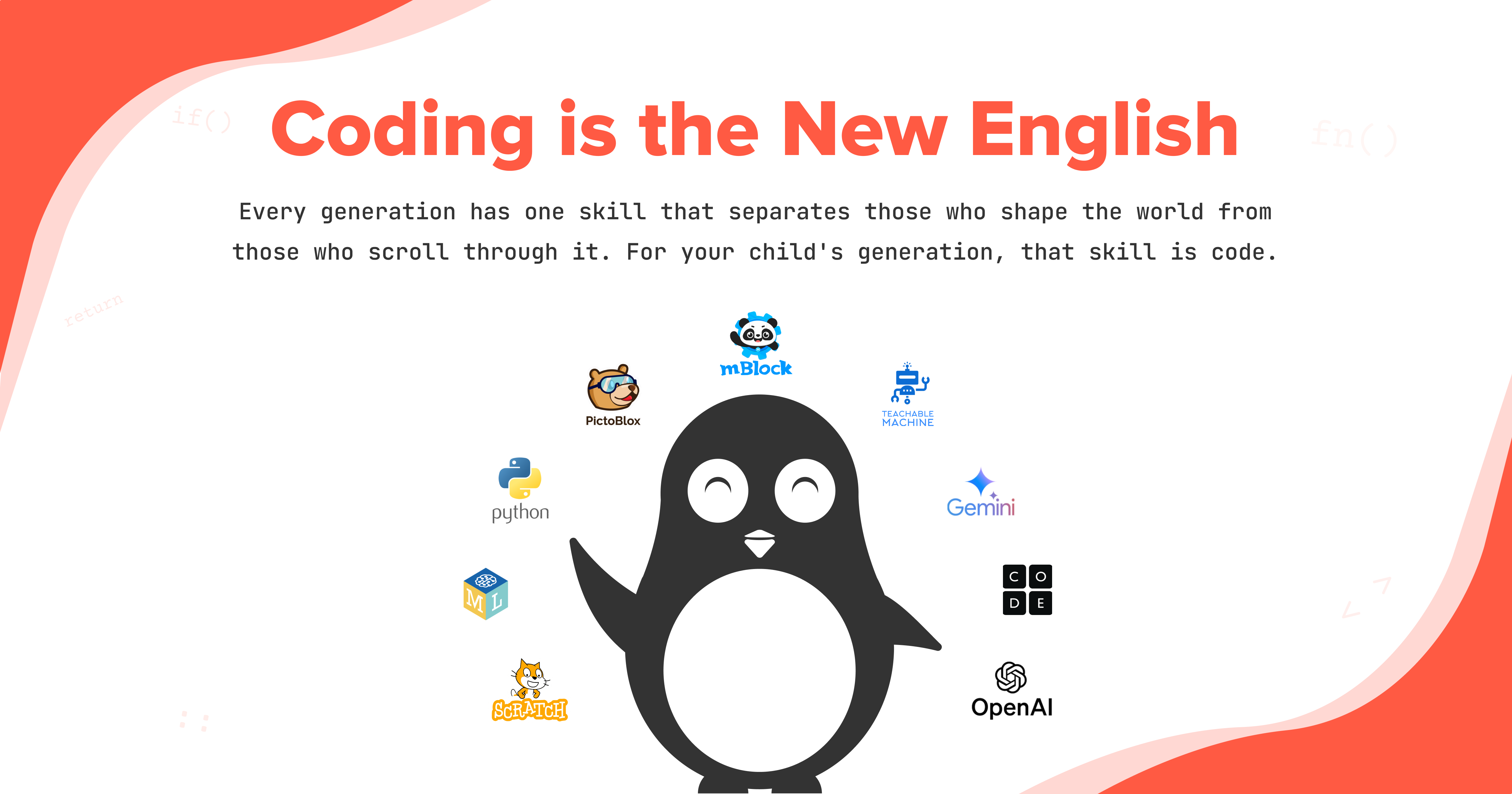
A Parallel Worth Taking Seriously What Coding Actually Is What happens when a child learns coding The AI Era Makes This Urgent What This Means for Parents Right NowEvery generation has one skill that changes everything. For your child’s generation, it is coding. Here is why it cannot wait.
A parallel worth taking seriously
Sometime in the twentieth century, a quiet revolution swept through households across the world. In India, parents enrolled their children in English-medium schools. In East Asia, families invested heavily in mathematics tuition. In Europe, a second or third language became a social expectation. The details differed by country, but the underlying logic was identical: parents recognised a shift in what the world would reward, and they acted before the window closed.
Those decisions compounded across generations. The children who built fluency in the right skills at the right moment did not just get better jobs. They got a fundamentally different relationship with opportunity.
We are standing at a similar inflection point today. The question is whether we will recognise it in time. Coding for kids is what English, mathematics, and digital literacy were for previous generations: the bridge skill that changes everything that comes after it. And if you have ever wondered why kids should learn coding when AI seems to be doing everything already, that is exactly the question this piece is written to answer.
The new bridge skill is coding. But here is what makes it different from every skill that came before: coding does not replace English or mathematics. It sits on top of both. When a child writes code, they are doing something simultaneously linguistic and mathematical. They are communicating intent with the precision that everyday language rarely demands and the logic that mathematics always requires. This is especially true today, when coding and AI for children are no longer separate conversations. Understanding how to write even basic code is what gives a child the ability to direct AI rather than simply use it.
What Coding actually is
There is a widespread misconception that coding is a technical skill, a narrow vocational competency suited to a particular kind of child. This misunderstands what coding is at its core.
Coding is the practice of translating human intention into precise, logical instruction. It starts with block-based environments that make logic visible and playful, and progresses into text-based coding that builds systems thinking and precision of expression. It requires you to define what you want, decompose it into steps, reason about what happens when things go wrong, and revise until the system does what you intended. These are not technical operations. They are cognitive ones.
Now add the AI dimension. Interacting meaningfully with an AI system, prompting it well, evaluating its outputs critically, building something useful on top of it, draws on language fluency, contextual awareness, logical thinking, and mathematical intuition together. Coding is not the new English. It is not new mathematics either. It is the skill that marries both, and the peer-reviewed evidence on what coding does to children’s brains confirms it is fast becoming the literacy that everything else rests on.
What happens when a child learns coding
Before Codingal, I spent over a decade teaching coding directly to children. Hundreds of students, one at a time, sitting across from me as they wrote their first working programme. That experience is what eventually convinced me that this needed to exist at scale. And across every one of those students, I observed the same moment. What I have seen since, as Codingal has grown to teach over one million children across 135 countries, is that this shift is not unique to any one country, culture, or type of child. It happens in students from Lagos and London, from São Paulo and Singapore, from small towns and major cities. What determines whether it happens is not ability or background. It is access to the right instruction, at the right stage of development, with a teacher who can guide without rescuing.
A child writes their first working programme. It does not have to be impressive: a simple game, a moving animation, a small tool that does exactly what they told it to do. They look at the screen. And something changes in how they see themselves.
Until that moment, the digital world was something that happened to them. After it, they understand they can make things happen in it. That is not a small shift. A child who has built something from nothing carries that experience into everything else they do. They become the kind of person who looks at a problem and asks how it works, not just what to do about it. They try things. They adjust. They do not wait for someone to hand them the answer.
That orientation, once developed, does not stay in the coding lesson. It goes everywhere. What determines whether it happens is not ability or background. It is access to the right instruction, at the right stage of development, with a teacher who knows when to step in and when to let the child figure it out.
The AI Era Makes This Urgent
Governments around the world are already responding. Finland introduced coding into its national curriculum in 2016. The United Kingdom made it compulsory in primary schools from age five. Singapore, South Korea, Australia, and Japan have all embedded computational thinking into their national education frameworks. India’s NEP 2020 has followed. This is not a trend. It is a global consensus forming in real time.
The reason is not that every child needs to become a software engineer. It is that AI is restructuring every industry, and the children who will thrive are not simply those who use AI tools, but those who understand how those tools work. A child who codes understands, at a structural level, how the AI systems defining their world actually function. They can interrogate those systems, build on them, and hold them to account. A child who cannot is growing up dependent on those who can.
English gave a generation of children entry into the global economy as participants in systems someone else had built. Coding offers something different: the ability to build those systems, to be on the side that decides how they work and who they serve. That is a meaningfully different kind of advantage, and the window to build it opens earliest in childhood.
What This Means for Parents Right Now
Every major technological shift in history has created a generation of children who were ready for it and a generation that was not. The difference was almost never talent. It was preparation, and the parents who recognised the shift early enough to act on it.
The answer today is the same as it was with English, with mathematics, with digital literacy: ensure your child builds the skill rather than merely consuming its outputs. Give them regular, structured, live online instruction from a teacher who can guide them through the experience of building something that works. The nine documented cognitive, academic, and career benefits of coding for children are real and measurable. The identity shift, from passive user to active builder, is irreversible. And the window to act is exactly now.
Every child who learns to code is claiming a seat at the table where the future is being decided. That is a right every child deserves, wherever in the world they are growing up.