Table of Contents
How to choose the right speech topic (in 60 seconds) Top 10 English speech topics (most-used picks) English speech topics by grade (pick what fits your level) Grades 3–5 (explain + one example) Grades 6–8 (opinions + reasons) Grades 9–12 (mature, structured, school-safe) Best topics for speech in English (quick-win shortlist) Unique topics for speech in English (stand out safely) 1-minute public speaking format (hook → 2 points → example → close) Delivery tips that make any topic sound better Practice checklist (7-day quick plan) Final Thoughts FAQs
Picking the right English speech topics can turn public speaking from stressful to fun.
Instead of choosing “big” topics that feel hard to finish, this guide helps kids pick topics they can explain clearly, support with one real example, and close confidently.
You’ll get grade-wise topic lists (1–2, 3–5, 6–8, 9–12), plus best topics for speech in English and unique topics for speech in English to help students stand out.
There are also mini challenges, quick tests, and short examples you can practice at home.
| 💡Fun fact: Most school speeches score higher when they include one specific example (a moment, a mistake, a win) instead of lots of facts. |
How to choose the right speech topic (in 60 seconds)
A good topic should feel like something your child can “own,” not something they must memorize. The fastest way is to match the topic to the time limit and the child’s real experiences. Parents can guide with questions, and kids can keep the words natural.
If your child can explain the topic in one line and add one example, it’s a strong pick.
The 60-second topic test
- Say it in one line: “My topic is ___ and I believe ___.”
- Name 2 points (or 3 for 2 minutes): “First… Second…”
- Add 1 example: “For example, last week…”
- End strong: “That’s why…”
Pro tip: If a topic needs a dictionary to get started, it’s probably too complex for a short speech.
Want your child to speak confidently in English? Book a free trial public speaking class for kids and get a topic recommendation + a ready 1-minute outline to practice immediately.
Top 10 English speech topics (most-used picks)
These are reliable choices when a student needs to pick fast. They are simple to explain, easy to structure, and school-safe for public speaking. Each topic works well with the 1-minute template later in this blog. If you want something rarer, jump to the “unique topics” section.
- My “small win” this week and what it taught me.
- A rule I used to dislike – but now understand.
- The kindest thing someone did for me.
- A mistake that helped me learn faster.
- A hobby that wakes up my brain.
- One thing I stopped doing that improved my day.
- The best question I asked this month.
- A place that helps me focus (at home or at school).
- What makes someone a good teammate?
- One habit I want to keep for life.

English speech topics by grade (Pick What Fits Your Level)
Grade-wise topics work because confidence grows when the topic matches vocabulary and thinking level. Younger kids do best with concrete topics they can describe clearly. Middle grades score better when they add reasons and a real example. Older students shine when they sound balanced and end with a clear takeaway.
Grades 1–2 (simple, concrete, personal)
For Grades 1–2, choose topics about things kids can see, feel, and describe. Keep it short, specific, and happy.
English speech topics for Grades 1–2
- The best smell in my home.
- My favorite quiet place.
- A toy that teaches me something.
- A snack I would invent.
- A sound that makes me calm.
- The funniest rule in my house.
- A gift I can give without money.
- My favorite classroom object.
- A time I helped someone.
- My brave moment (small is okay).
- A costume I would design.
- My favorite English word and why.
- A happy habit I want to keep.
- A game that teaches sharing.
- A story scene I remember most.
- A pet I would care for (and how).
Grades 3–5 (Explain + One Example)
For Grades 3–5, kids can explain “why” and add one example. Pick topics that connect to school, friends, sports, or home routines.
English Speech Topics for Grades 3–5
- My best learning mistake and what it fixed.
- If my classroom had a mascot, it would be…
- A tiny invention that would help students.
- A compliment that changed my mood.
- One change that made my day better.
- A skill I learned outside textbooks.
- The best way to calm down quickly.
- A time I helped without being asked.
- If I could redesign homework, I would…
- What makes a fair game?
- A character I would invite to my school.
- One habit that saves me time daily.
- The best question I asked this week.
- A family food story (and what it teaches).
- The one-minute trick I use to focus.
| 💡Fun fact: Teachers remember speeches with a clear “for example” line more than speeches packed with definitions. |
Grades 6–8 (opinions + reasons)
Grades 6–8 students can share opinions with reasons. Choose topics that allow 2–3 reasons plus one real example.
Unique English speech topics for Grades 6–8
- The one school change that would reduce stress.
- Why can boredom be useful?
- The most underrated skill: listening.
- A habit that protects mental peace.
- My personal rule for safe internet use.
- Why practice beats talent (with one story).
- Being busy vs being productive.
- The best way to handle peer pressure.
- Why is kindness also smart?
- What makes a role model real (not perfect)?
- Why “small discipline” changes big results?
- How to respond to negative comments respectfully?
- Why is asking questions a strength?
- A technology that helps learning (and one risk).
- A time I changed my mind (and why).

Grades 9–12 (mature, structured, school-safe)
Older students score well when they sound organized and balanced. Pick topics where you can add a clear stance and one respectful counterpoint.
English speech topics for Grades 9–12
- The hidden cost of multitasking (and one fix).
- Confidence is a skill, not a gift.
- Motivation vs discipline (what actually works).
- Why boundaries matter for students?
- Sleep education matters as much as study plans.
- How social media affects attention (and one solution)?
- The value of saying “I don’t know”.
- Why misinformation spreads (and how to stop it)?
- Communication skills matter more than marks.
- Leading without being loud.
- Digital privacy in daily life.
- Why curiosity is a career advantage.
- Empathy is a real-life strength.
- The pressure to be perfect (and a healthier mindset).
- How to learn faster with practice and review?
Senior-level challenge: Add one line that starts with “Some people think…, but I believe…” and keep it respectful.
Best topics for speech in English (Quick-Win Shortlist)
These topics usually score well because they’re easy to structure and easy to personalize. They work for school assemblies, class speeches, and beginner competitions. Parents can help by asking for a real example from daily life. Kids should choose a topic they can explain without “searching for words.”
Best topics for a speech in English
- The power of small habits.
- Why is asking questions a strength?
- Confidence grows with practice.
- Listening is a superpower.
- How to handle failure calmly?
- Good friendships and respect.
- Smart screen time balance.
- Teamwork and leadership.
- Gratitude as a daily habit.
- Time management for students.
- Learning from a mistake.
- Clean surroundings, clear mind.
Unique topics for speech in English (Stand Out Safely)
Unique topics sound fresh because they are personal and specific. They don’t need big facts; they need a clear angle and one strong example. These topics help students avoid the “everyone says the same thing” problem. They’re also perfect for public speaking practice at home.
Unique topics for speech in English
Unique topics don’t mean strange topics. They mean familiar ideas with a fresh angle that sounds personal and thoughtful. These topics help students stand out in competitions and feel more original in class.
They also create natural hooks because they feel specific and unexpected. Use these if your child wants something different from the usual “save trees” list—while still staying school-safe.
- The most useful “no” I learned to say.
- The best five-minute habit before an exam.
- A small daily choice that changed my confidence.
- Why is silence powerful?
- The difference between being popular and being respected.
- The one app feature I would redesign to protect focus.
- A lesson I learned from a younger child.
- What would my future self thank me for?
- A problem I solved alone (and what I learned).
- The smartest way to deal with negative comments.
- Why boredom can make you creative?
- The best advice I ignored (and what happened).
- The “one rule” that improved my friendships.
- Why celebrating effort beats celebrating talent?

1-minute public speaking format (hook → 2 points → example → close)
A short speech becomes easy when students follow one clear pattern. This format prevents rambling and helps kids finish on time. Parents can coach using the steps without rewriting the child’s words. Try it with any topic from the grade lists above.
1-minute template
- Hook (10 sec): question / surprising line / tiny story
- Point 1 (15 sec): What it means
- Point 2 (15 sec): why it matters
- Example (10 sec): one real moment
- Close (10 sec): one takeaway line
Example (Topic: “The best question I asked this month”)
- Hook: “Have you ever asked a question and felt instantly smarter?”
- Point 1: Questions help us understand, not memories.
- Point 2: Questions show confidence.
- Example: “I asked for one step again, and my doubt disappeared.”
- Close: “One good question can change the way you learn.”
Ready to practice this today? Try a free session where a coach helps your child deliver the same speech with better pauses, confidence, and a stronger closing.
Delivery tips that make any topic sound better
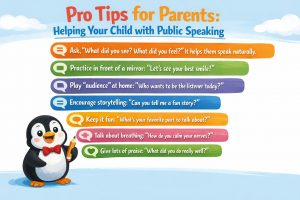
Even a great topic can sound weak if the delivery is rushed or monotone. Simple delivery changes – like pausing and eye contact – can raise the quality of any speech instantly. This section is parent-friendly because it focuses on coaching behaviors, not memorizing lines. Kids can also treat it like a game: improve one delivery skill each day. The goal is to sound natural, clear, and confident.
Quick delivery upgrades
- Pause after each point (it makes you sound mature)
- Slow down on the hook and closing (these get remembered)
- Look up after every sentence (not the whole time)
- Use one hand gesture per point (keep it simple)
- Smile once (it relaxes your voice)
Two-line voice hack: Record once, then replay and reduce speed by 10%. Repeat once more.
Practice checklist (7-day quick plan)
Practice works best when it is short, consistent, and stress-free. This plan takes about 10–12 minutes a day and builds confidence gradually. Parents can support by timing the speech and praising effort, not perfection. By Day 7, most kids sound smoother and more comfortable.
7-day plan
- Day 1: choose topic + write hook + 2 points
- Day 2: add one example line
- Day 3: practice pauses after each point
- Day 4: practice eye contact (look up after sentences)
- Day 5: practice timing (under 70–80 seconds)
- Day 6: practice expression (calm tone)
- Day 7: stage mode (standing + strong ending)
| ✔️ Pro tip: Record one practice and improve only one thing per day. That keeps practice fun. |
Final Thoughts
Public speaking becomes easier when kids speak about something they truly understand. Pick a topic that fits the grade, follow the 1-minute structure, and add one real example. With short daily practice, confidence grows naturally without memorizing heavy lines. When the speech sounds real, it becomes memorable.
Want personalized feedback on your child’s speech? Book a free trial class to get quick feedback on topic choice, structure, and delivery—so your child sounds clear, confident, and school-ready.
FAQs
- What are English speech topics for public speaking?
English speech topics for public speaking are ideas that students can explain clearly in English within a short time. Good topics feel familiar, allow two or three points, include one real example, and end with a simple takeaway that sounds confident. - How do I choose an English speech topic for my child’s grade?
Start with the time limit, then pick a topic your child has experienced at school or at home. Ask for two reasons and one example. If they can explain it in ten seconds, the topic fits their grade perfectly today. - What are the best topics for speeches in English for school assemblies?
Choose school-safe topics that feel positive and practical, such as habits, gratitude, teamwork, learning from mistakes, or respectful online behavior. These topics are easy to structure, fit one or two minutes, and sound mature without heavy research for most students. - What are unique topics for speech in English that still stay school-friendly?
Pick a familiar theme with a fresh angle, like “a rule I changed my mind about” or “the best question I asked this month.” Keep it personal, avoid sensitive debates, and add one clear example from daily life to win. - What is the best 1-minute public speaking structure for students?
Use a simple flow: hook, two points, one example, and a closing takeaway. Spend about ten seconds on the hook, fifteen seconds per point, ten seconds for the example, and finish with a confident final line that listeners remember best. - How can my child start a speech confidently in English?
Start with a question, a surprising fact, or a tiny story from real life. Then clearly say the topic in one sentence. Practise the first two lines five times, because a strong opening reduces stage fright quickly for most kids. - How many points should a short speech include?
For a one-minute speech, use two main points and one example. For two minutes, use three points and one example. More points usually cause rushing. Clear points, slow pace, and a strong closing earn better marks in school speeches today. - How can we practice public speaking at home without making it stressful?
Keep practice short and playful. Set a timer for ten minutes: outline in two, speak once in three, improve one thing in three, and perform again in two. Record on a phone, praise effort, and repeat tomorrow for steady progress.