Table of Contents
Why Public Speaking Matters for Kids How to Start Building the Skill at Home 6 Fun Public Speaking Games for the Whole Family Golden Rules for Parents Handling Nervousness in Kids When to Consider Public Speaking Classes for Kids Final Thoughts FAQs
Here’s a truth most parents don’t realise: public speaking for kids isn’t about performing in front of hundreds of people. It’s about helping your child say what they mean – clearly, calmly, and with confidence. And it starts at your dinner table, not on a stage.
Why Public Speaking Matters for Kids
From class presentations to college interviews to job pitches – the ability to speak clearly and confidently shapes your child’s future in more ways than one. Yet it’s one of the most underrated skills parents think about.
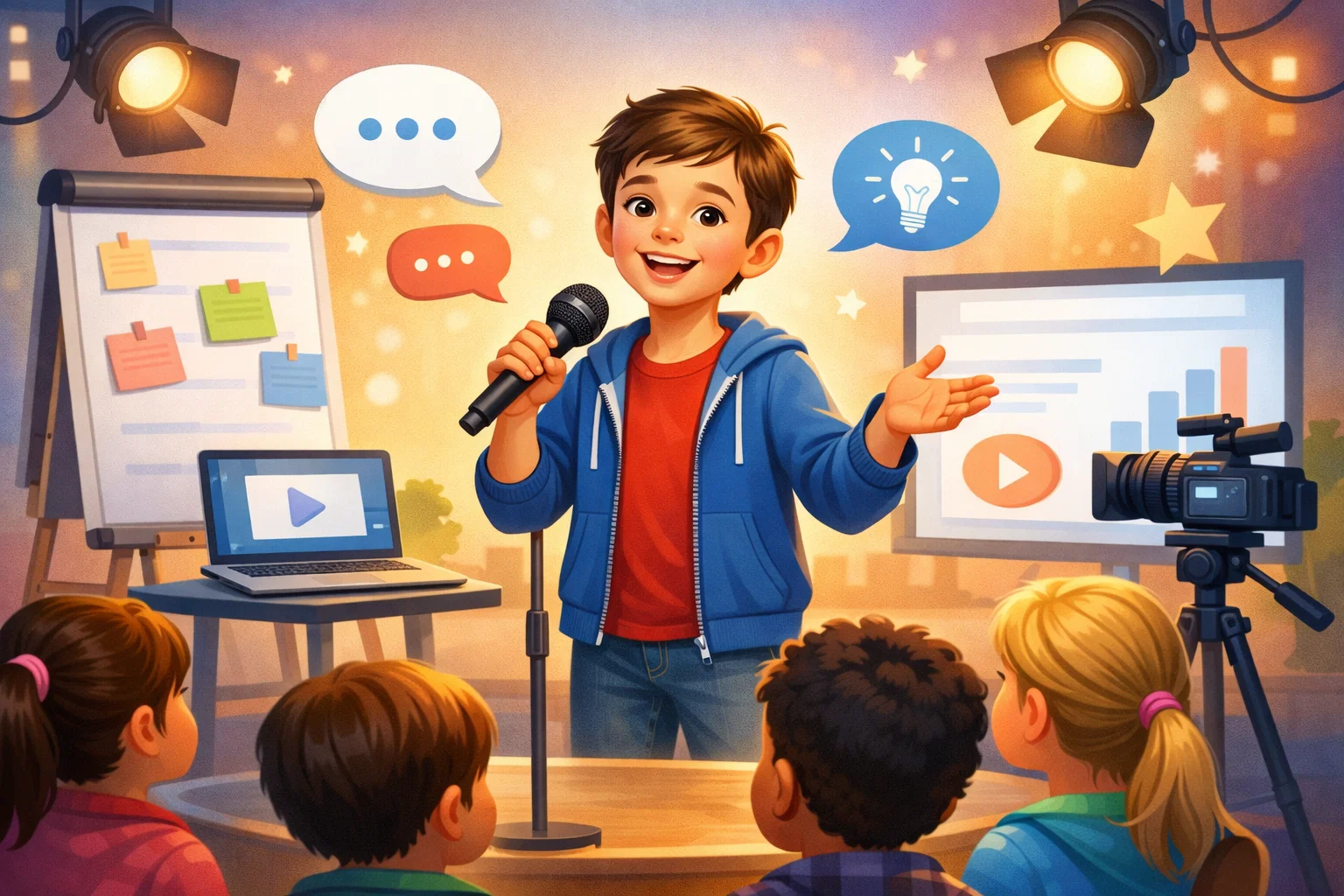
Public speaking for kids isn’t limited to debate competitions or school speeches. It’s the skill behind raising a hand in class, making a new friend, explaining their idea, or standing up for themselves. When children learn to communicate well early, the benefits ripple into every area of their lives.
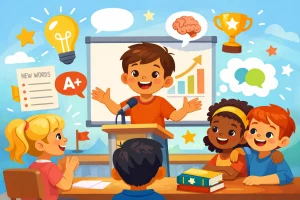
The goal, of course, isn’t to turn every child into a TED Talk speaker. The goal is expression – not perfection.
🏠 How to Start Building the Skill at Home
Before jumping into public speaking classes for kids, the best training ground is actually your living room. Home is low-pressure, judgment-free, and already familiar — the perfect setting for a nervous beginner.
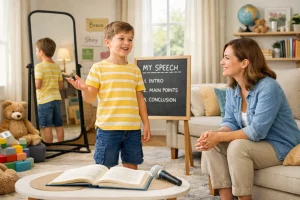
Here’s how to build a simple daily routine that works even for the shyest child:
- The Daily 2-Minute Talk: Ask your child to speak for 2 uninterrupted minutes about anything- their day, a cartoon, what they ate for lunch. Resist the urge to correct or interrupt. Just listen. This builds the habit of sustained, unscripted talking.
- Mirror Practice: Have your child stand in front of a mirror and introduce themselves, describe a hobby, or tell a short story. Mirrors build self-awareness – children notice their posture, facial expressions, and eye contact naturally.
- Read Aloud Together: Take turns reading a book or article out loud. Focus on pace, volume, and expression rather than accuracy. Reading aloud is one of the most effective (and underused) tools for voice confidence.
- Narrate Everyday Moments: While cooking or driving, ask your child to “narrate” what you’re both doing, like a sports commentator. This builds spontaneous speaking ability and reduces the fear of thinking on their feet.

🎲 6 Fun Public Speaking Games for the Whole Family
The secret to helping kids speak confidently? Make them forget they’re “practising.” These games are designed to remove the pressure and replace it with laughter – and they work for ages 5 to 15.
🎭1. Pretend News Reporter
Transform your living room into a newsroom. Ask your child to report “breaking news” from home – maybe the dog stole a sock, or dinner is running late. They can interview family members or announce the weather forecast for tomorrow.
This game builds voice modulation, structure, and the habit of speaking to an “audience.” Kids naturally adopt a newsreader’s clear, steady tone without being asked.
📦2. Mystery Box
Fill a box with random household objects – a spoon, a keychain, a rubber band, a sock. Your child reaches in, pulls something out, and speaks about it for 1–2 minutes: what it is, how it’s used, and a made-up story about it.
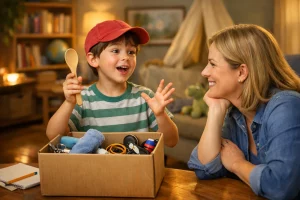
This is fantastic for spontaneous thinking and creative expression. It also gently mimics the experience of being handed an unexpected topic in a speech or interview — a real-world skill.
🎤3. Pass the Mic
Grab a toy microphone, a spoon, or even a TV remote. Each family member gets 1 minute to speak on a topic, then passes the mic. Topics can be fun (“Why Mondays should be banned”) or thoughtful (“The best thing that happened this week”).
This game is wonderful for family bonding and normalising the act of speaking up – your child sees parents and siblings doing it too, which dissolves the idea that public speaking is scary or special.
🎲4. Spin & Speak
Write fun topics on slips of paper and fold them into a bowl: “If I were a superhero,” “My dream school,” “Why animals are amazing,” “What I’d do with a million rupees.” Your child picks one at random and speaks for 1–2 minutes – no preparation allowed.
This simulates the unpredictability of real speaking situations and builds the crucial ability to think and talk at the same time.
🎬5. Story Building Game
One person starts a story with a single sentence: “Once upon a time, a dragon moved into our apartment building…” Each family member adds one sentence, going around the circle. See where the story goes – the stranger, the better.
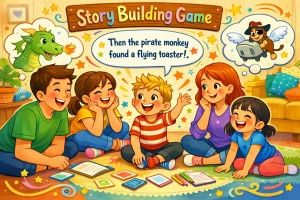
Beyond the laughs, this game builds listening skills, narrative structure, and the ability to connect ideas on the spot – all cornerstones of great public speaking.
🧠6. Emotion Challenge
Give your child a neutral topic – “My morning routine” – and then assign an emotion: happy, angry, terrified, deeply bored, overly excited. They must deliver their talk using that emotion as authentically as they can.
This is one of the best exercises for voice expression, body language, and emotional intelligence. It teaches children that how you say something is just as important as what you say.
🎯 Golden Rules for Parents
The biggest influence on a child’s speaking confidence isn’t a class or a coach – it’s the response they get at home.
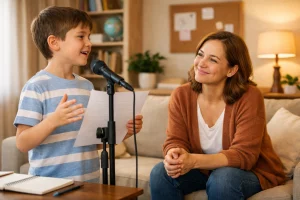
Here’s how to be the audience your child needs:
Handling Nervousness in Kids
Stage fright is one of the most common fears in the world — not just in children. In fact, studies suggest that public speaking anxiety affects roughly 75% of the global population at some level. So when your child says “I’m scared,” they’re in excellent company.
The key is not to eliminate nervousness – it’s to help your child make friends with it. Here’s what works:
The 4-Step Calm-Down Sequence
Teach this to your child before any speaking moment – big or small.
Remind your child: nervousness means your body is getting ready to do something important. The butterflies don’t disappear for great speakers – they just learn to fly in formation.
🏫 When to Consider Public Speaking Classes for Kids
Home practice is powerful, but there comes a point where public speaking classes for kids can take your child’s skills to the next level. A structured class introduces something home practice can’t fully replicate: a real audience of peers, a trained coach, and progressive challenges.
Consider enrolling when your child:
✅ Has mastered home activities and wants more challenge
✅ Struggles with anxiety that home practice alone isn’t reducing
✅ Is preparing for a specific goal – debate team, drama, interviews
✅ Thrives in structured social environments with peers
Here are the main types of public speaking classes for kids available today:
Public speaking classes for kids are widely available through schools, community centres, dedicated coaching studios, and online platforms. Many offer trial sessions – always start there before committing to a full programme.
🌟 Final Thoughts
Public speaking for kids is not a talent some children are born with and others aren’t. It’s a skill – one that grows with practice, encouragement, and a little patience.
The child who stumbles through a 2-minute talk at the dinner table today is building exactly the same muscle as the one who gives a confident school presentation three months from now. The gap between the two isn’t talent. It’s practice.
Whether you start with games at home, a mirror on the bedroom wall, or a structured public speaking class – what matters most is that your child knows: their voice is worth hearing.
From living room practice to real confidence with peers, Codingal makes the journey exciting. Explore coding for kids classes that help children strengthen communication, logic, and self-expression.
FAQs
1. What is public speaking for kids?
Public speaking for kids is the skill of expressing thoughts clearly and confidently out loud. It includes storytelling, presentations, and everyday conversations – not just formal stage performances.
2. At what age should kids start learning public speaking?
Children can begin as early as age 4–5 through simple storytelling and show-and-tell. Formal public speaking classes for kids are typically best suited for ages 6 and above.
3. How can I teach public speaking to my child at home?
Start with daily 2-Minute Speech Topics For Students, mirror practice, and fun family games like Pass the Mic. Consistent short sessions at home build confidence naturally without pressure or formal instruction.
4. What are the best public speaking classes for kids?
Top options include debate clubs, drama classes, Toastmasters Youth, and online speaking programmes. The best public speaking classes for kids prioritise encouragement over competition and offer real peer-audience practice.
5. Why is public speaking important for children?
It builds confidence, sharpens vocabulary, develops leadership qualities, and reduces anxiety. Children who speak well perform better academically, form stronger friendships, and grow into more effective communicators in professional life.
6. How do I help my child overcome fear of public speaking?
Normalise nervousness, practice in safe low-pressure settings, and use the 4-step calm-down technique: deep breath, smile, find a friendly face, and start slowly. Confidence grows through repetition – not perfection.
7. Are online public speaking classes for kids effective?
Yes, especially for shy beginners. Online public speaking classes for kids offer video feedback, flexible scheduling, and a less intimidating environment – making them an excellent starting point before in-person training.
8. What are some fun public speaking activities for kids?
Try Pretend News Reporter, Mystery Box, Spin & Speak, and the Emotion Challenge. These games remove performance pressure, encourage creativity, and build speaking skills through play rather than formal practice.
9. How long does it take for a child to become a confident speaker?
With consistent daily practice of just 5–10 minutes, most children show noticeable improvement within 4- 6 weeks. Enrolling in public speaking classes for kids can further accelerate progress significantly.
10. What should parents avoid when helping kids with public speaking?
Avoid interrupting mid-speech to correct mistakes, setting unrealistic expectations, or forcing performances before the child is ready. Praise effort over perfection and let your child progress at their own pace.