I remember the first time I watched a seven-year-old, in one of our live online sessions, understand what she had just done.
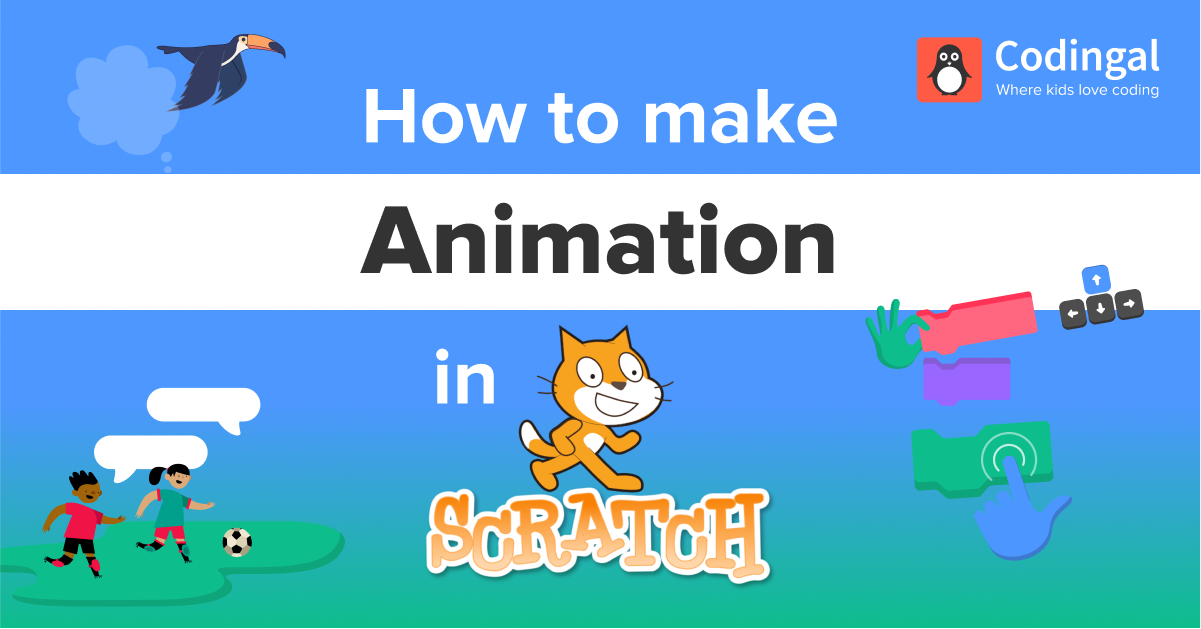
She had been building a simple animation in Scratch for about twenty minutes: a cat that moved across the screen when she pressed the spacebar. She dragged a block, ran it, dragged another, ran it again. Then she pressed the green flag, and her cat walked from one side of the screen to the other, turned around, and came back.
She looked at her screen, then at the camera, and said: “I made it do that.”
Not “I finished the task.” Not “I got it right.” “I made it do that.” Four words that mark the exact moment a child moves from being a user of technology to being someone who shapes it. That shift is what block-based coding for kids makes possible, in a first session, at age seven.
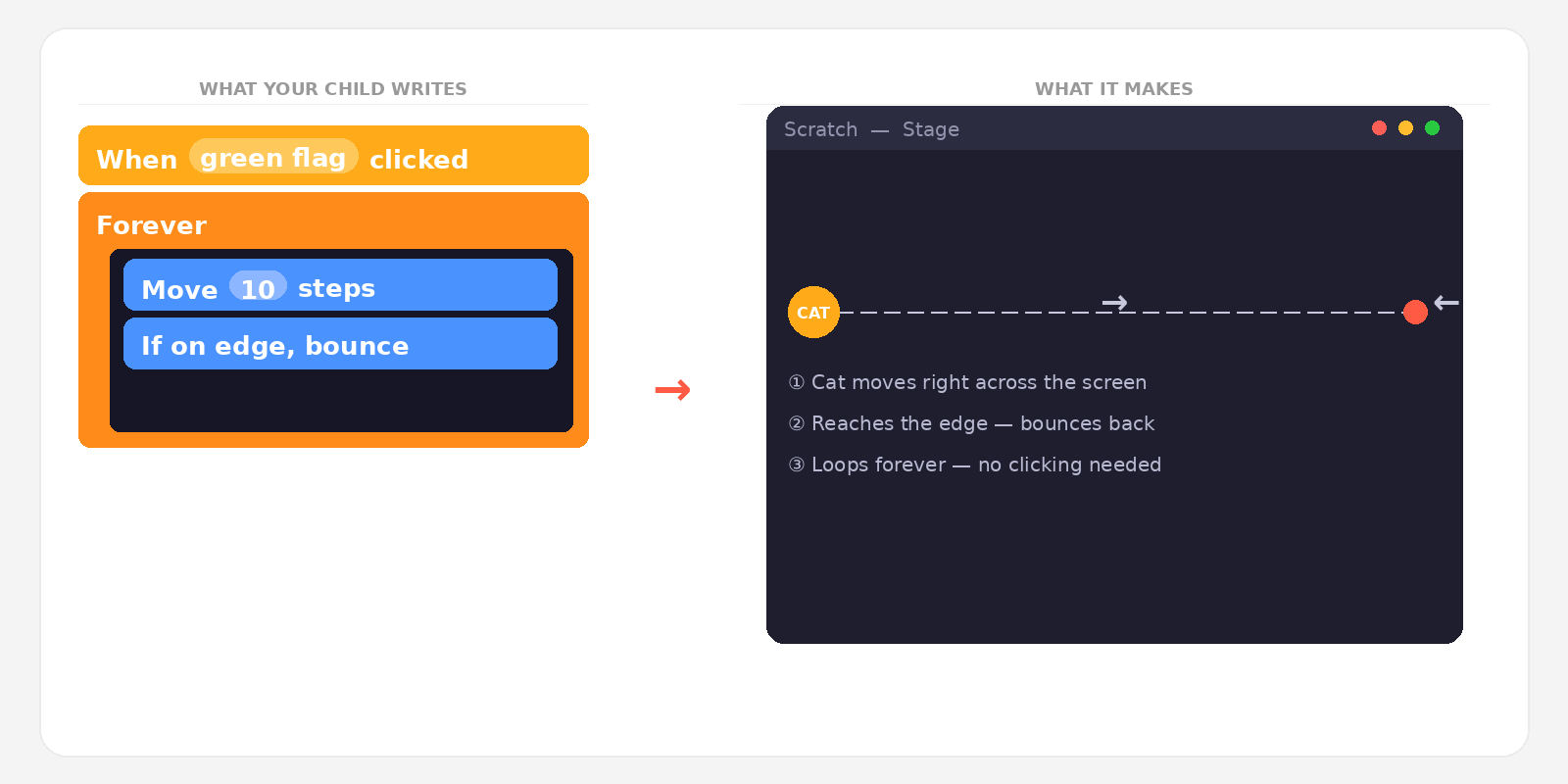
That is what I am building towards every time I design a lesson. And it is why I want to address something I hear often: that Scratch and similar environments are a lesser form of programming, something children do before they can handle “real” code.
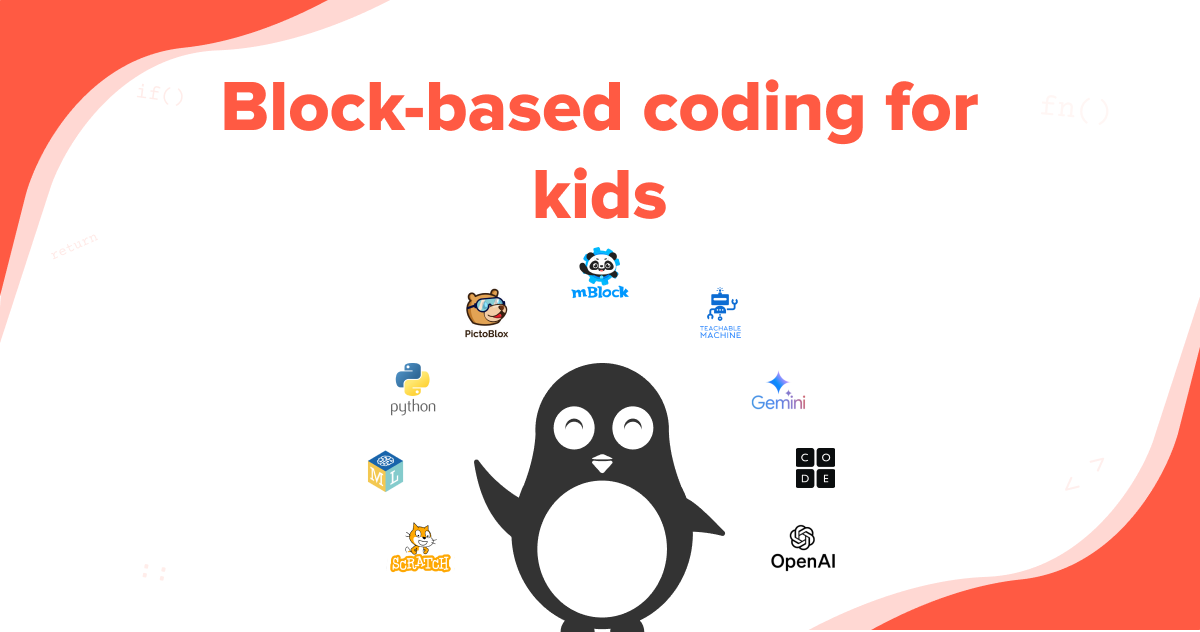
Block-based coding for kids is not ‘baby coding’
The idea that block-based environments like Scratch or Blockly are a warm-up act for real programming misunderstands what coding is actually about.
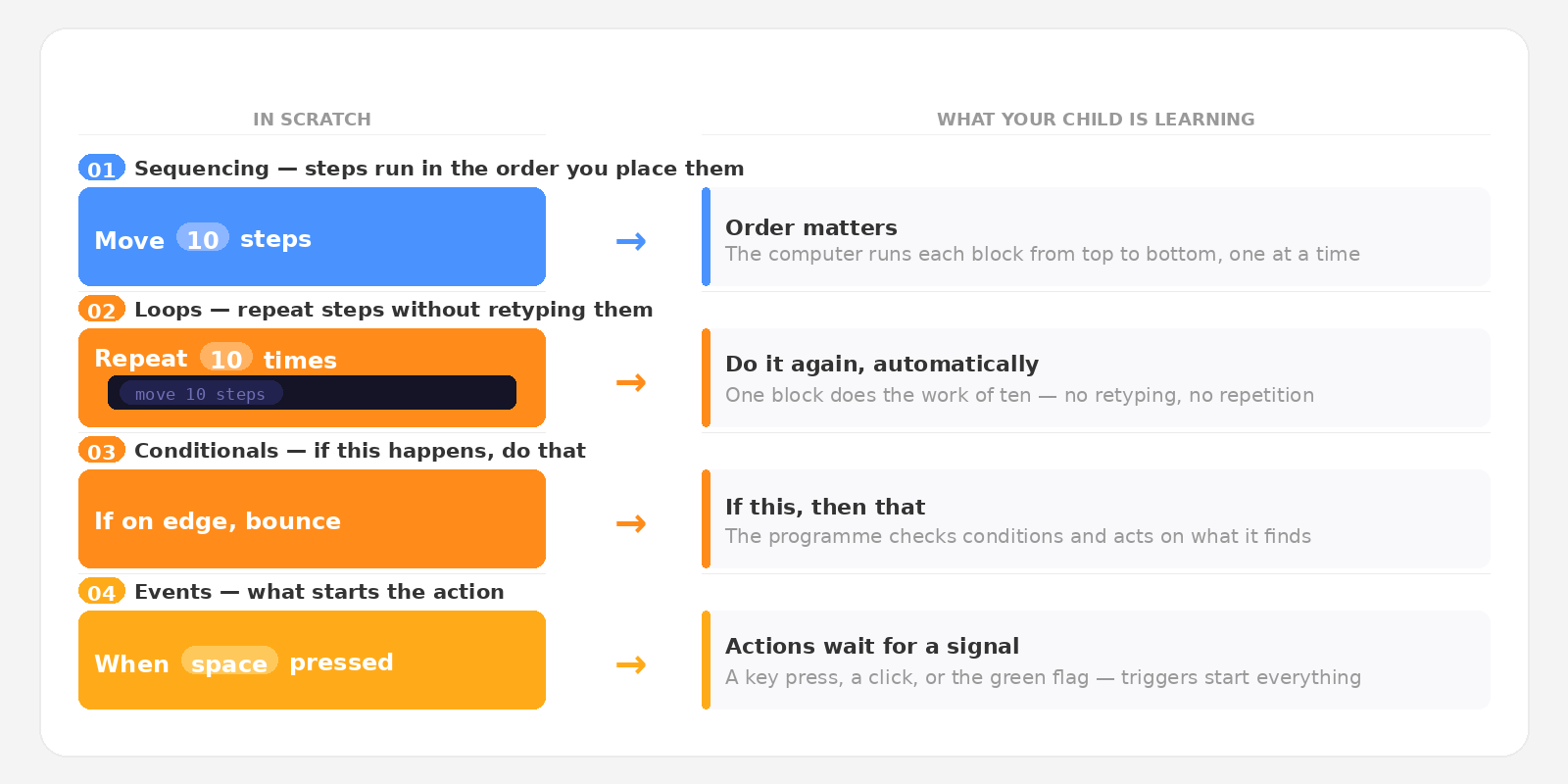
Coding is not, at its core, about syntax. Syntax is just the notation, the particular way instructions get written down. The real substance of coding is the thinking underneath it: putting steps in the right order, making things repeat, writing rules for when different things should happen, breaking a big problem into smaller, manageable pieces. Every one of these ideas is fully present in a block-based environment. A child building a game in Scratch is reasoning about all of them, not in the abstract, but through a problem they care about solving.
Researchers studying early coding education at institutions like Boston College describe block-based environments as playgrounds for the mind. The act of dragging, connecting, and running blocks is not a simplified version of programming. It is the cognitive work of programming, designed so that a child’s developing brain can engage with it at the age when they are most ready to do so. Research on the benefits of early coding consistently identifies this as one of the highest-impact windows for building logical thinking skills.
What your child is actually doing when they move blocks around
When I design a block-based coding lesson, I am not designing a simplified Python class. I am building a specific learning experience around four things I know about how young children develop skills that stay with them.
Immediate feedback builds real understanding
When a child drags a block, runs the programme, and sees what happens, the feedback is instant and visible. Ideas like “loops” and “if/then rules” do not need to be explained first and practised later. Children encounter the concept in action, understand it through what they see on screen, and then put a name to it. That order, experience before explanation, is how young children build knowledge that actually sticks. This is not a teaching shortcut. It is what research on how coding affects a child’s brain shows is most effective at this age.
Logic should feel like play, not instruction
Every lesson I design starts with a question, not a definition. Not: “Today we are going to learn about loops.” Instead: “How would you make your character dance the same move ten times without clicking ten separate blocks?” The child discovers the loop because they need it, not because the schedule demands it. A concept discovered that way is owned, not just memorised.
Confidence comes first, not last
In my years of teaching children to code, the biggest barrier was rarely about thinking ability. It was about how children felt about themselves. Children who said “I am not good at this” or “coding is not for me” were not describing ability. They were describing their experience so far. They had never been given a coding environment where success came quickly, where errors were easy to spot and easy to fix, and where building something real was possible from the very first session.
Block-based coding creates exactly that environment. Mistakes show up immediately and can be corrected with a drag and a click. A child who builds something that works in their first session carries a different sense of what they are capable of into every session that follows.
Blocks are the bridge to everything that comes next
The block-based journey at Codingal does not end with animations. It is the starting point for understanding how AI and text-based programming work. Children who understand conditional logic through blocks (if this, then that) find the same idea much easier to recognise when they meet it in Python, and again when they see how an AI uses the same principle to make decisions.
As my colleague Amith Singh describes in his piece on why text-based coding builds systems thinkers, the concepts do not change between Scratch and Python. Only the form changes. The child who has spent time in Scratch already understands the logic. They just need to learn to write it. What I have seen, again and again, is that children who arrive at more advanced concepts with strong block-based foundations do not find them frightening. They find them interesting.
What to look for when choosing a block coding programme
Not all block-based coding instruction is equal. The visual format is accessible. The quality of teaching behind it is not guaranteed. When you are looking at a programme for your child, these are the things worth asking about.
Project-led outcomes: Children should be building something real by the end of every session, not just completing worksheet-style exercises. The project is what makes the concept meaningful. If your child cannot point to something they made, the lesson has not landed.
A teacher who can see your child: A teacher who can observe where a child’s thinking has gone wrong and guide them back is not replaceable, especially in the early stages. Self-paced video programmes have their place, but live, personalised feedback is what builds genuine understanding.
Concepts before definitions: A good programme introduces an idea through a challenge before giving it a name. Discovery first, then the word for what was discovered. That order matters more than most curricula acknowledge.
A clear path forward: Block coding should be a beginning, not an end point. Look for a programme with a structured, gradual path from block-based to text-based coding, ideally with consistent teaching and curriculum throughout. The documented benefits of coding for children compound when the learning is joined up rather than fragmented.
Every child who sits in front of a block-based coding environment for the first time is a builder who does not yet know it. Within a few live sessions, if the teaching is right, they will. That moment (which our co-founder Satyam Baranwal describes as the defining shift in a child’s coding journey) is not the end of the story. It is the very beginning of one.
Take the next step
At Codingal, block-based coding is the foundation of everything we teach, from Scratch animations to Python and AI concepts. Every session is live, taught by a teacher who knows your child’s pace and adjusts in real time. Book your child’s free trial class and let them build their first “I made it do that” moment.