10 science-backed benefits of coding for kids
The benefits of coding for kids go deeper than most parents expect. It sharpens the brain like learning a second language, teaches children to treat failure as data rather than defeat, and builds the communication and collaboration skills that matter in every classroom and career. A landmark meta-analysis of 56 studies confirmed these gains are consistent across every age group.
Join 1000+ students who took a lesson in the last 24 hours!
Students
Countries

4.6 / 5 stars
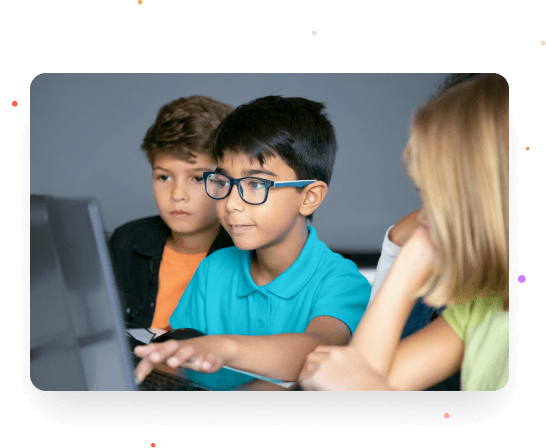
10 benefits of coding, each grounded in peer-reviewed research
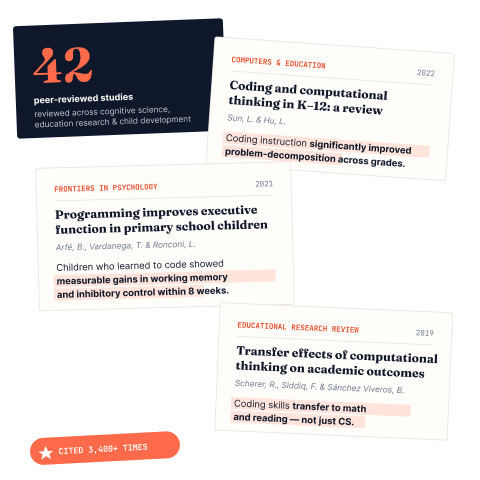
TL;DR
Poor academic performance is rarely a motivation problem. It's a sign the brain hasn't been trained to think systematically - and coding is the most effective way to do that.
Children who code break problems into steps, think more precisely, and apply what they've learned across subjects - not just in computer science.
Executive function, working memory, and inhibitory control aren't soft skills. They're the cognitive systems most strongly linked to academic success - and coding measurably strengthens all three.
The kids who keep performing well as school gets harder share one trait: they treat every problem as something that can be figured out - not something that happens to them.
More screen time won't help. More homework won't either. Changing how your child thinks about problems will - and that's exactly what coding does.
Coding supercharges your child's brain development.
Of all the benefits research has documented, this is the one that surprises parents most, and impresses developmental scientists equally. Coding does not just teach children to write instructions for a computer. It measurably strengthens the executive functions of the brain: the systems responsible for planning, focus, working memory, and self-control. Research consistently shows that a child's ability to plan, focus, and regulate their own behavior predicts academic success more reliably than raw IQ. The primary school years are the best window to develop them and it's the strongest reason why kids should learn to code before secondary school, not after.
One month of coding produces planning improvements equivalent to or greater than 7 months of standard academic activities
🔬 Research Basis: Ribner et al. (2020), NCBI; Montuori et al. (2025), Computers and Education

What This Means for Your Child
When your child is debugging code, they are not just fixing a programme. They are training the neural pathways responsible for planning, self-regulation, and focused attention: the same systems that determine how they handle exams, manage their time, and approach every challenge for the rest of their life.
Coding builds problem-solving skills children use in every subject.
One of the largest independent reviews of coding research ever published found that learning to code produces bigger improvements in problem-solving than almost any other activity studied, particularly in younger children. Researchers have identified specific thinking skills that coding strengthens, all of which show up directly in how children perform at school and it's why learning to code matters.[14]
Causal reasoning
Understanding cause, effect, and sequential logicSpatial reasoning
Visualizing layouts, movement & relationships between elementsAlgorithmic thinking
Understanding how instructions affect outcomes for others🔬 Research Basis: Ciftci & Bildiren (2020); Montuori et al. (2024), Computers and Education
What This Means for Your Child
Parents consistently report the same observation: within months, their child's approach to problems outside coding (mathematics, writing, even interpersonal conflicts) changes. Problems that once provoked frustration are met with: 'Let me break this down.'

For a deeper look at how systems thinking develops through text-based coding, read Why Text-Based Coding Builds Minds That Think in Systems.
— Amith Singh, from Codingal's curriculum team
Coding develops computational thinking: The literacy of the modern era.
Professor Marina Umaschi Bers of Boston College describes this as a shift from passive to builder orientation.[6] Children who develop computational thinking stop seeing problems as things that happen to them. They begin approaching every challenge, academic, personal, and professional, with the same systematic curiosity and confidence.
Research with kindergarten-age children showed that children as young as 4 can engage meaningfully with core principles of computational thinking.[5] It's why kids should learn to code before habits of mind are set.
🔬 Research Basis: Ribner et al. (2020), NCBI; Montuori et al. (2024), Computers and Education

What This Means for Your Child
A child who thinks computationally does not wait to be shown the answer. They break the problem apart, test one thing at a time, and adjust when something does not work. Parents notice this shift first in how their child handles frustration.

"Two years at Codingal taught me my ideas don't have to stay in my head."
From the Codingal Classroom
— Zaviyar Khattak, Codingal student
Children who code perform measurably better in writing and mathematics.
A peer-reviewed study of 49 fifth-grade students in Google's CS First Storytelling lessons found unambiguous results: significant increases in writing scores, idea development, essay organization, grammar, and stamina.[8]
The math connection is equally well-established. Coding applies variables, functions, conditional logic, and sequences in a context where the purpose is immediately visible.[3] When children meet these concepts through code, they become tools with a purpose, not rules to memorize.
The result across multiple studies is improved mathematical intuition.[14] For parents still asking whether learning coding is worth it, gains across the two most assessed school subjects is a hard case to argue with.
🔬 Research Basis: Google CS First Study, ScienceDirect (2021)
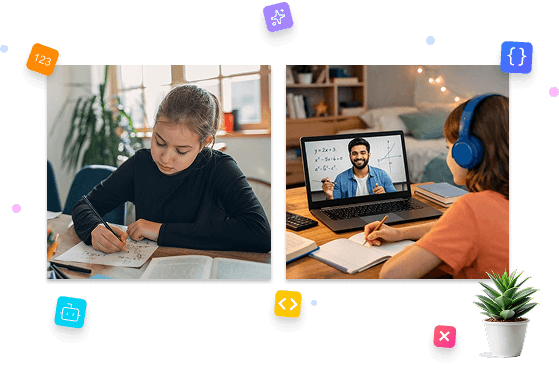
What This Means for Your Child
When children meet mathematical abstractions through code, they encounter them as tools with a purpose. The result, consistently documented across multiple studies, is improved mathematical intuition and problem-solving ability.
How Python's structure turns abstract maths into something children navigate with purpose - Why Text-Based Coding Builds Minds That Think in Systems.
— Amith Singh, from Codingal's curriculum team
Coding builds confidence and resilience through the act of making things.
When a child builds something that works, the experience is qualitatively different from receiving a grade on an essay or a score on a test. Building produces a different kind of knowing.
Completing a working project, whether an app, a game, or an animation, delivers a sense of mastery that passive learning cannot replicate. This is what builds confidence. Debugging is a structured rehearsal for failure. Children learn to treat errors as information, test multiple approaches, and persist. These are habits of mind, not techniques: resilience. Research by Bers finds that children who build with technology stop seeing themselves as consumers and start seeing themselves as creators.[6] It's the most underrated answer to why learn to code.
🔬 Research Basis: Bers, M.U. (2020), Coding as a Playground; Flannery & Bers (2013)
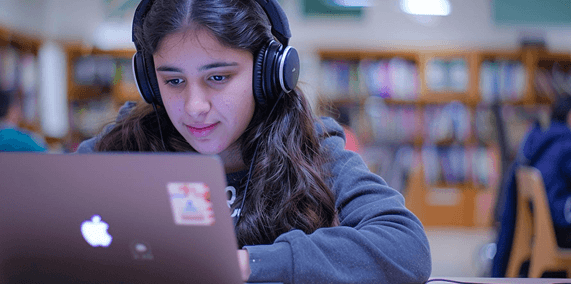
What This Means for Your Child
The moment a child's code runs for the first time, something shifts. They built that. Not with help, not from a template. That experience of authorship is what confidence is actually made of, and it compounds every time they build something harder.

Explains how block-based coding provides a science-backed foundation showing exactly where and how the journey begins.
Curious how children as young as 5 begin building this thinking?
— Freeda Kakara, from Codingal's curriculum team
Starting coding earlier produces measurably larger cognitive gains.
The common parental instinct is to treat coding as something to introduce later, around secondary school, but research suggests the opposite. A controlled study of 437 children across two groups, ages 5 to 7 and 8 to 10, found both groups improved in executive function, with consistently larger gains in the younger group. Still weighing the timing? Is learning coding worth it answers that question directly.
Critical developmental window (ages 5-10)
Brains are highly receptive to logic, patterns, and structured thinking during primary school years.Earlier is easier
Skills that feel natural at age 7 often require significantly more effort to learn by age 12.Strong foundation for all learning
Starting coding early builds cognitive abilities that support academic success across subjects for years to come.🔬 Research Basis: Ciftci & Bildiren (2020); TangibleK (2013); ScienceDirect (2025)

What This Means for Your Child
Most parents assume the window opens at secondary school. The research says it's already closing. What clicks naturally at age 7 takes significantly more effort to develop at 12, and the cognitive foundations built in primary school compound across every subject for years afterward.

If you're thinking about why this matters beyond future job titles, Codingal's Co-founder Satyam Baranwal lays it out best: Coding Is the New English — Why Every Child Deserves a Seat at the Table. The case isn't about careers. It's about literacy.
Children who code enter the workforce with a measurable and lasting advantage.
The economic case for coding education is unambiguous. Computing and information technology careers are among the fastest-growing, highest-paying, and most resilient occupational categories globally. The career advantage extends well beyond software engineering.
A marketing professional who works with data saves their team weeks every quarter. A manager who understands how AI tools work makes better decisions. Research from the US Bureau of Labor Statistics and the WEF projects that 70% of STEM-related jobs now require coding and AI expertise.[9][10]
For a plain breakdown of what that means for your child, read is learning coding worth it.
🔬 Research Basis: US Bureau of Labor Statistics (2021); WEF Future of Jobs Report (2025)

What This Means for Your Child
The child in fifth grade who learns to code isn't just learning a skill. They're building the foundation for roles that don't yet have names. Across every field (medicine, finance, education, design), the professionals who understand how technology works will direct the ones who don't.
"Code has become the 4th literacy. Everyone needs to know how our digital world works, not just engineers."
— Mark Surman, Executive Director, Mozilla Foundation
Coding that children enjoy produces compounding learning gains.
A peer-reviewed study of 86 children aged 9 to 12 examined the link between enjoyment and learning outcomes in coding workshops[7]. The mechanism is specific: fun does not directly produce learning. It shapes attitudes toward coding, and those attitudes influence how much children believe they have learned and how motivated they are to continue. When coding feels engaging rather than intimidating, children come back to it voluntarily. That return is what drives compounding gains over time. It's the clearest answer to why learn to code before motivation becomes a battle.
🔬 Research Basis: ScienceDirect (2021), structural equation modeling

What This Means for Your Child
A child who finds coding enjoyable does not need to be pushed to practice. They return to it. That voluntary return is what separates children who develop genuine fluency from those who complete a course and stop. Enjoyment is not a nice-to-have in coding education. It is the mechanism.
AI makes coding more important, not less.
The most frequently asked question parents ask today is a reasonable one: if AI can write code, why should my child bother learning? The premise needs examination. AI generates syntax. It cannot define the problem worth solving, judge whether a solution is correct, or reason about tradeoffs. Those are human capabilities, developed specifically through building things with code.
The WEF Future of Jobs Report projects 170 million new roles in the coming decade, with AI for kids and technology as the fastest-growing sectors.[10] Children in first grade today will enter the workforce during a period when every industry will require people who understand how technology thinks. The question is not whether coding matters. It is how soon they begin.
🔬 Research Basis: WEF Future of Jobs Report (2025); Sam Altman, OpenAI (2025)

What This Means for Your Child
A child who understands how technology thinks will not be replaced by AI. They will be the person directing it. That distinction will determine career trajectories in ways we are only beginning to map.
"When I was graduating, the obvious tactical thing was to get really good at coding. Getting good at AI tools is the new version of that."
— Sam Altman, CEO, OpenAI
Opens the Door to Robotics & Engineering
Coding is the native language of robotics and the entry point to the physical world of STEM. Coding and robotics are not separate disciplines. They share the same foundational thinking. Children who code consistently outperform peers in STEM subjects and demonstrate stronger spatial reasoning, which is one of the strongest predictors of engineering aptitude.
Age 6+Can program physical objects
Spatial reasoning beyond screenSTEM connectionDirect pathway
Robotics, biomedical, autonomous systemsThrough 2030Fastest-growing roles
Robotics & automation (WEF)🔬 Research Basis: Bers, Flannery, Kazakoff & Sullivan (2014), TangibleK Robotics Curriculum; WEF Future of Jobs (2025)
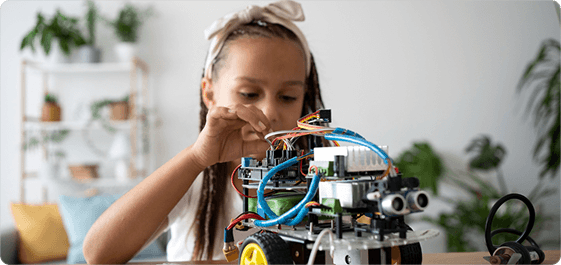
What This Means for Your Child
A child who has learned to give precise instructions to a computer has already built the core thinking skill that makes robotics intuitive rather than overwhelming. Starting with Scratch for kids is one of the most effective ways to build that foundation. Professor Marina Bers's TangibleK research at Boston College found that children as young as 6 could program physical objects, developing spatial reasoning and systems thinking that extended far beyond the screen.
Robotics and STEM
Coding and robotics are not separate disciplines. They share the same foundational thinking. Children who code consistently outperform peers in STEM subjects and demonstrate stronger spatial reasoning, which is one of the strongest predictors of engineering aptitude. Python for teens is where that foundation becomes a direct pathway into robotics and engineering.
Every parent I speak with wants the same thing: a child who is genuinely prepared for whatever comes next. What the research kept showing us, and what we see every day inside Codingal classrooms, is that one skill is doing more for children's cognitive development, academic confidence, and long-term resilience than almost anything else in the curriculum. The ten benefits on this page are peer-reviewed findings, replicated across thousands of children, and recognized by education policymakers worldwide. Coding does not just add a skill. It changes how a child thinks, how they handle difficulty, and how they see themselves when they face a problem they have never encountered before. That shift, once it happens, stays.

If you're wondering specifically what happens inside your child's brain when they code, Codingal's Co-founder & CEO Vivek Prakash's deep dive into the neuroscience is the clearest summary we've seen.
Impact on students
Helping children build confidence, curiosity and real skills
Explore our courses
Coding, AI, Math, and Public Speaking courses to spark creativity and future-ready skills, with flexible self-paced paths for every learner.

AI and Machine Learning
Master the fundamentals of AI and machine learning

Scratch Programming with AI
Learn coding with visual blocks and AI concepts

Python Champion
Become a Python programming expert

Game Development for Kids
Create your own games from scratch

Website Development
Build modern, responsive websites

App Development for Kids
Create mobile apps for iOS and Android

AI & Data Science for Teens
Analyze data and build AI models

Roblox Champion
Design and code games on Roblox

AP Computer Science A
Prepare for the AP CS exam

IOI Algorithms
Master competitive programming
About Codingal
Codingal is a fast-growing edtech company on a mission to help kids fall in love with coding and AI through live classes and hands-on projects. What makes this journey special is our people: teachers, builders, and problem-solvers who genuinely care about learning.
We work as one team across curriculum, engineering, design, growth, operations, and support, always improving how we teach, how we train teachers, and how students learn. If you are a teacher who loves mentoring, or a parent looking for a learning experience that is personal, structured, and future-ready, welcome.

Frequently asked questions
Research supports starting as early as age 4-5 with screen-free or block-based tools.[5] Ages 6-8 represent the highest-impact window: children's brains at this stage are unusually receptive to the structured, logical thinking that coding builds.[13] That said, starting at any age before secondary school delivers real benefits. Children who begin earlier simply arrive at each stage with more to build on.
It is one of the most consistently documented findings in education research. A major independent review across 56 coding studies found that coding produces bigger improvements in problem-solving than any other educational activity studied.[3] Two independent studies involving hundreds of children found large, measurable improvements in planning and focus.[1][2] The evidence is not anecdotal.
Yes, and the reason is stronger than ever. AI generates syntax. It cannot define the problem worth solving, evaluate whether the output is correct, or reason about tradeoffs. The children who will direct AI tools most effectively are those who understand how code works. As Sam Altman observed in 2025, learning to work with AI tools is the new version of learning to code well.[11]
No. Research and classroom experience consistently show that children develop mathematical intuition through coding, rather than needing it in advance. Coding gives mathematical abstractions a purpose: variables, functions, and logic become tools the child uses to build something they care about. Many parents report that their child's relationship with mathematics improved after starting coding, not the other way around.
Codingal delivers live, one-to-one instruction with a qualified teacher in every session. Research consistently shows that learning outcomes in coding are highest when a teacher can observe where a student's reasoning breaks down and guide them through it in real time. Pre-recorded content and passive apps cannot replicate this. Our curriculum is STEM.org-accredited, project-based, and designed to progress with each individual student.
Documented cross-subject benefits include: mathematics (procedural thinking, pattern recognition, applied logic)[3], writing and language (a Google CS First study found significant improvements in essay scores and writing stamina after coding lessons)[8], and general metacognitive skills - the ability to plan, self-monitor, and self-correct.
Not inherently, and for many children, coding is actually the easier entry point. Mathematics often requires abstract thinking in isolation; coding gives every abstract concept a concrete purpose. Variables become containers the child uses to build something. Logic becomes the rule that makes their game work. Many parents report that their child's confidence in mathematics improved after starting coding, because the same thinking becomes purposeful rather than theoretical. Children who struggle with abstract maths often find that coding gives them a way in.
The research does not measure IQ directly, but the cognitive gains are well-documented and specific. A major meta-analysis across 56 coding studies found that coding produces the largest improvements in problem-solving and executive function of any educational intervention studied.[3] Executive functions - which include planning, working memory, and inhibitory control - are the cognitive systems most strongly associated with academic success and real-world capability. Coding measurably strengthens these systems, particularly in children aged 6 to 12.[1]
The honest answer: coding requires patience, and initial progress can feel slow. Children who expect instant results sometimes find the early debugging phase frustrating. Screen time is a legitimate concern for some parents, though structured coding instruction is categorically different from passive consumption - a child actively building something is cognitively engaged in the way that watching content is not. Cost and access are real barriers for many families, which is why platforms with free entry points matter. The research consistently shows that when coding instruction is well-structured, teacher-guided, and progressive, the challenges are temporary and the benefits are durable.
The career case is unambiguous. The US Bureau of Labor Statistics projects software development roles growing at 17 percent over the next decade, roughly four times the average for all occupations.[9] But the career argument extends well beyond software engineering. A marketing professional who can work with data, a doctor who can read AI diagnostics, a teacher who can build learning tools: all of these roles increasingly require coding and computational thinking. The WEF Future of Jobs Report 2025 projects 170 million new roles by 2030, concentrated in technology, AI, and data.[10] Children beginning coding today are not preparing for one career path. They are building the foundational thinking that almost every future role will require.
Elon Musk began programming at around age 10, teaching himself BASIC from a manual and building a video game called Blastar, which he sold for approximately USD 500 at age 12. Mark Zuckerberg began coding at age 10-11 under his father's tuition. Bill Gates started at age 13 through his school's computer club. Steve Jobs began exploring electronics and programming as a teenager. The pattern across many of the most influential technologists of the last 50 years is consistent: early exposure, structured progression, and a project that mattered to them personally. The research on developmental windows confirms what their stories illustrate: starting in the primary school years produces outcomes that late starters cannot fully replicate.
In a school context, coding benefits show up across multiple dimensions. Academic performance: students who code show measurable improvements in mathematics and writing, two of the core assessment subjects in most curricula.[3][8] Classroom behaviour: executive function improvements from coding translate into better attention, task-persistence, and self-regulation in class.[1] Collaboration: coding projects taught in group or paired settings consistently improve communication and cooperative problem-solving. Teacher feedback at Codingal regularly notes that students who code approach classroom challenges differently: they decompose problems, test solutions, and treat errors as data rather than failures.
More so, not less. AI automates code generation, not code understanding. The engineers, analysts, and product managers who will direct AI systems most effectively are those who understand how code works: what it can and cannot do, how to evaluate its output, and how to debug it when it fails. Sam Altman observed in 2025 that getting good at AI tools is the new version of getting good at coding.[11] For children, this means coding education is not about competing with AI. It is about building the foundational literacy that makes someone an effective director of AI, rather than a passive recipient of whatever it produces.
Coding is the act of writing instructions in a programming language. Computational thinking is the broader set of cognitive skills that coding develops: decomposing problems into smaller parts, identifying patterns, abstracting away unnecessary detail, and designing step-by-step solutions. You can have computational thinking without coding (a chess player or a surgeon uses it), but coding is one of the most effective ways to build and practise it systematically. For children, this distinction matters because the goal of coding education is not to produce programmers. It is to build a way of thinking that transfers across every domain they will encounter.
Sources & Research
All claims on this page are grounded in peer-reviewed research. Inline citation numbers [N] link directly to the references below.
Ribner, A. et al. (2020). Coding in Primary Grades Boosts Children's Executive Functions. PMC / NCBI. Study 1: 76 first-graders (ages 5-6), 8 coding lessons; Study 2: 38 second-graders.
View SourceScienceDirect (2025). Age-related effects of coding interventions on executive functions. 437-student cross-age controlled study (first graders and fourth graders). Effect sizes d=1.44-1.53 (planning), d=0.80-1.10 (inhibition).
View SourceMontuori, C., Gambarota, F., Altoe, G., and Arfe, B. (2024). The cognitive effects of computational thinking: A systematic review and meta-analytic study. Computers and Education, 210, 104961.
View SourceCiftci, S. & Bildiren, A. (2020). The effect of coding courses on the cognitive abilities and problem-solving skills of preschool children. Computer Science Education.
View SourceBers, M.U., Flannery, L., Kazakoff, E.R., and Sullivan, A. (2013). Computational thinking and tinkering: Exploration of an early childhood robotics curriculum (TangibleK). Computers and Education, 72, 145-157.
View SourceBers, M.U. (2023). The Benefits of Teaching Kids to Code. Boston College Magazine, Fall 2023.
View SourceScienceDirect (2021). Fun, attitude, and perceived learning in children's coding workshops. 86 children ages 9-12. FunQ instrument. Structural equation modelling. Key finding: Fun > Attitude > Perceived Learning.
View SourceScienceDirect (2021). Learning to code and elementary students' writing skills. 49 fifth-grade students, Google CS First 'Storytelling' lessons. Mixed-methods. Significant improvement in writing scores, organisation, grammar, and stamina.
View SourceUS Bureau of Labor Statistics (2021). Occupational Outlook Handbook: Computer and Information Technology Occupations. Median annual wage $97,430. Projected growth +15% over 10 years.
View SourceWorld Economic Forum (2025). Future of Jobs Report 2025. 170 million new roles projected by 2030. AI and technology as fastest-growing sectors. 92 million roles displaced; net increase of 78 million.
View SourceAltman, S. (2025). Quote reported in Fortune, March 2025. 'When I was graduating, the obvious tactical thing was to get really good at coding. Getting good at AI tools is the new version of that.'
View SourceSurman, M. Mozilla Foundation. 'Code has become the 4th literacy. Everyone needs to know how our digital world works, not just engineers.' Mozilla Foundation Executive Director.
View SourcePiaget's Concrete Operational Stage (ages 7-11). StatPearls, National Center for Biotechnology Information (NCBI), NIH. Also: Cognitive Competence as Positive Youth Development Construct, PMC.
View SourceChokthitirath, W. (2021). A Literature Review on Coding Skills for Children in a Disruptive Technology Era. ResearchPublish Journals, Vol. 9, Issue 4, pp. 46-50. Reviews 4 reasoning dimensions strengthened by coding: causal, spatial, verbal, and social.
View SourceCodingal is backed by esteemed angel investors
Codingal has secured substantial backing from renowned investment firms and a host of prominent angel investors.