Top-rated online Math camp for kids & teens in 2026
Codingal offers live 1:1 and group Math Camps for kids and teens ages 6 to 17. Master concepts, strengthen problem-solving skills, and build confidence in Mathematics through engaging, interactive lessons taught live by expert Math instructors. Camps are available every season with a limited-time 50% discount. Learners can join from anywhere in the world, no commute, no prior advanced math knowledge required.
Few slots remaining, hurry up!
CAMP50
Coupon Code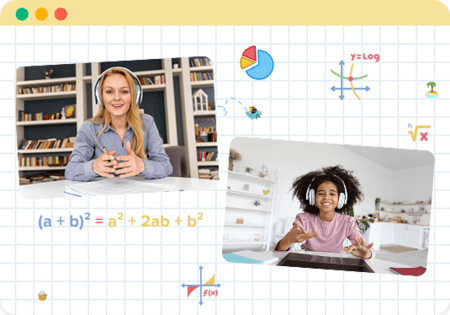

Age group
6-17 years

Program delivery
Online

Batch size
1:1 & group classes
(group classes based on availability)

Sessions
5 to 8
(45 minutes each)

Duration
5 to 8 days

Certification by
STEM.org
Built by alumni of


Backed by


Accredited by

Choose from personalized Math camps for your child
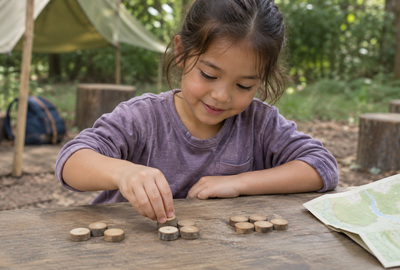
The Grand Counting Quest: Count to 120
This course covers reading and writing numerals to 120, number words (matching numerals to written names), counting forward to 100 and beyond from any starting point, counting backward with fluency, one more and one less than a given number, comparing numbers using number lines and base-ten blocks, sequencing and ordering numbers with visual supports, and Grand Counting Quest challenge (mixed fluency and ordering tasks).
Learning outcomes
Read and write numerals and number words accurately up to 120
Count forward and backward within 120 with fluency, including from any starting point
Identify one more and one less than a given number
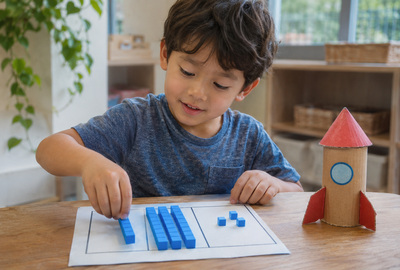
Space Mission: Tens and Ones
This course covers launching place value (bundling ones into tens), tens and ones in two-digit numbers with base-ten blocks, expanded form and standard form, comparing numbers with greater-than, less-than, and equals symbols, ordering numbers on number lines, ordinal numbers (describing position), and Space Mission consolidation (building, comparing, and ordering challenge).
Learning outcomes
Identify the tens and ones that make up any two-digit number
Compare and order two-digit numbers using place value reasoning and symbols
Express numbers in expanded form and standard form

The Market Day Addition Mission
This course covers addition within 10 using manipulatives and visual aids, addition within 20 on the number line, zero in addition and subtraction (the role of the placeholder), subtraction within 10 with concrete models, subtraction within 20 with multiple strategies, the inverse relationship (fact families for addition and subtraction), adding and subtracting multiples of 10, and Market Day word problems (applying strategies in shopping contexts).
Learning outcomes
Solve addition and subtraction problems within 20 using multiple strategies
Explain the role of zero in addition and subtraction
Add and subtract multiples of 10

The Funfair Navigator: Shapes and Directions
This course covers positional language (above, below, left, right, beside, between), directional movement (following and giving instructions with turns), navigating grids with coordinate-based directions, attributes of 2D shapes (sides, corners, and curves), composing 2D shapes from pattern blocks, attributes of 3D shapes and building with solids, partitioning shapes into equal parts, and Funfair Navigator challenge (combined shape-and-direction games).
Learning outcomes
Describe positions and directions using accurate spatial language
Navigate grids by following and giving coordinate-based directions
Identify attributes of 2D and 3D shapes

Addition Investigation: School Supplies
This course covers place value review (hundreds, tens, and ones), three-digit addition on the number line, addition without regrouping, expanded-form addition strategy, introducing regrouping with base-ten blocks and place value charts, addition with regrouping in the ones place, addition with regrouping across tens and hundreds, and School-supplies word problems (solving and verifying solutions).
Learning outcomes
Add multi-digit numbers with and without regrouping
Explain place value relationships in three-digit addition using concrete models
Use expanded form as an addition strategy
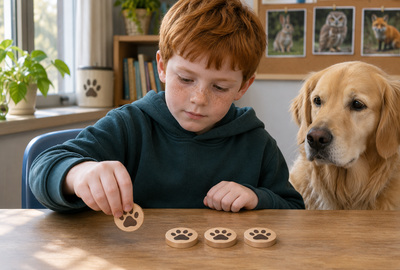
The Pawsitive Subtraction Mission
This course covers subtraction strategies on the number line, subtraction without regrouping, visualizing regrouping with concrete models, subtraction with regrouping, checking subtraction using inverse addition, and Pet-care word problems (choosing and applying strategies).
Learning outcomes
Subtract multi-digit numbers with and without regrouping
Explain regrouping using concrete and visual models
Check subtraction using the inverse relationship with addition

2D Shape Puzzle Solving on Fix-It Street
This course covers identifying and classifying shapes by attributes, straight and curved lines in shapes, drawing shapes with specified attributes, symmetry (folding and line symmetry in 2D shapes), classifying triangles and quadrilaterals, pentagons, hexagons, and cubes, and Fix-It Street puzzle challenge (composing shapes from smaller shapes).
Learning outcomes
Identify and classify 2D shapes by their attributes
Draw shapes with specified attributes using rulers and templates
Identify lines of symmetry in shapes

Fair Time: Measuring Everything
This course covers measuring length in centimeters and meters, measuring weight in kilograms and grams, measuring capacity in liters and milliliters, telling time on analog clocks, telling time on digital clocks, and Fair-day applications (timing rides and estimating measures).
Learning outcomes
Measure length using centimeters and meters
Measure weight using kilograms and grams
Measure capacity using liters and milliliters
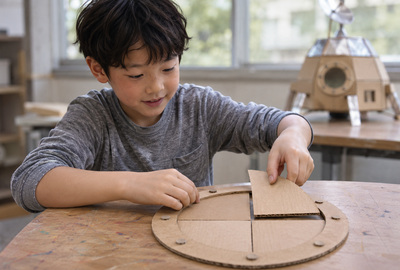
Spaceship Fractions: Navigate the Cosmos
This course covers fractions as equal parts of a whole, representing fractions on the number line, comparing fractions with visual models, equivalent fractions with fraction bars and circles, ordering fractions by size, tenths as fractions, converting tenths to decimal notation, and Cosmos navigation challenge (mixed fraction reasoning).
Learning outcomes
Represent fractions on number lines and with visual models
Compare and order fractions accurately using visual reasoning
Recognize and generate equivalent fractions
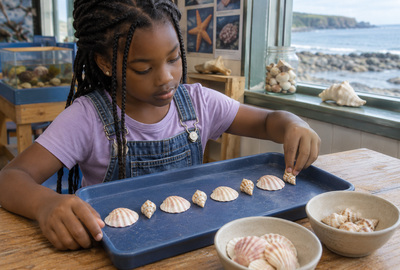
Geometric and Numeric Patterns Beneath the Sea
This course covers identifying the rule in numeric patterns, extending numeric patterns, creating original numeric patterns from rules, recognizing geometric patterns, extending geometric patterns, representing patterns visually with diagrams, equality and solving simple equations using patterns, and Beneath-the-sea applications (patterns in real-world contexts).
Learning outcomes
Identify patterns and extend them by finding governing rules
Create original numeric and geometric patterns following specified rules
Represent patterns visually and connect them to real-world contexts
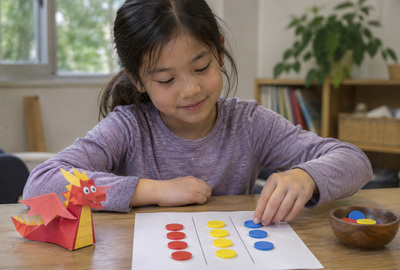
Data Handling Dragons: Mission Unlocked
This course covers grid positions and coordinates, collecting and organizing data in tables, displaying data in pictograms, displaying data in bar graphs, solving one-step and two-step problems from data, simple experiments and recording outcomes, and Dragon mission challenge (full data investigation).
Learning outcomes
Describe grid positions using coordinates
Collect, organize, and display data in tables, pictograms, and bar graphs
Solve one-step and two-step problems using data
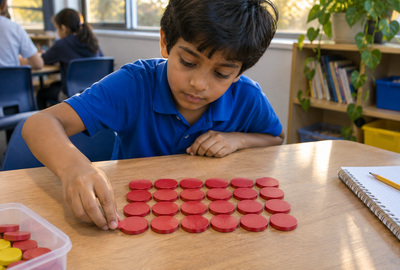
Brainy Times: Multiplication Discovery
This course covers equal groups and repeated addition, arrays and area models of multiplication, the 2 times table, the 5 and 10 times tables, properties of multiplication (order, zero, and one), multiplying larger numbers without regrouping, multiplying with regrouping, and multiplication word problems with visual support.
Learning outcomes
Represent multiplication using arrays, equal groups, and area models
Recall multiplication facts for 2, 5, and 10 fluently
Use the properties of multiplication, including multiplying by zero and one

Foundations first. Always.
Every concept your child will ever need sits on one of these pillars. Master them early and Math stops being hard. Skip them and it never gets easier.

Number Sense
Counting, place value, number bonds. The foundation every concept sits on.

Fractions & Decimals
Visual teaching using Polypad fraction bars. Concepts before calculations, every time.

Algebra Foundations
Variables, equations, functions, and patterns from pre-algebra through advanced, mapped to grade and board.

Probability
Dice, coins, and real experiments understood through Polypad simulations before any formula appears.

Geometry
Shapes, angles, area, and volume made visual with GeoGebra. Students see the relationship, not just the formula.

Measurement
Length, mass, time, and capacity with real-world problems connected to your child's actual board.

Data Handling
Collecting, organising, and interpreting data - charts, graphs, and real datasets, not textbook exercises.
Math camp vs Math classes for kids?
Most families start with a camp, see what their child loves, then continue in regular classes. No semester commitment, pay per camp, switch tracks any time.
| Format | What it is | When to pick it |
|---|---|---|
Math camp | Short, intensive (5 to 8 days). Ends with a finished project. | School breaks, summer, first-time learners who want fast momentum. |
Math class | Ongoing weekly lessons (1 - 2 per week). | Once your child has the basics and wants to keep building. |

How a Math camp works?
Live 1:1 & small-group math classes · 24/7 AI tutor support · Lifetime class recordings · Gamified tests & interactive worksheets · STEM.org accredited certificate · 100% money-back guarantee.
Pick a camp
Pick the camp that fits your child's age and grade.
Meet your instructor
Matched with an experienced Math instructor. 91% of our educators are women.
5-8 live sessions
45-minute live classes with real-time teacher feedback in every session.
Earn your certificate
A completed skill milestone and a STEM.org accredited certificate, every single camp
The Codingal LPAAR Methodtm
Built on STEM, Bloom's Taxonomy, BIDE, and the Goldilocks Principle.
Every Codingal Math class follows a five-step structure grounded in how children actually build understanding, rather than simply receiving information and being expected to retain it.
Learn
See it in concept
Your child's tutor never opens with a formula. They open with a visual, something your child can see and make sense of, so the concept feels real before any rule is introduced.
Practice
Solve it together
The tutor doesn't solve it for your child. They solve it with them, on the same board, working through it together until it clicks.
Apply
Do it independently
Then your child tries it alone. The tutor is still there, watching, but they step back and let your child work through it without help.
Assess
Check while it's fresh
A quick check-in right after - not a test, just a way to make sure the concept has landed before the class moves on.
Reinforce
Make it permanent
A worksheet goes home with your child at exactly the right difficulty level, so the concept stays with them long after the class ends.

Every class is pitched at exactly the right level for your child, challenging enough to stretch them but never so difficult that they switch off. This is the Goldilocks Principle, and it's the reason Codingal students stay engaged long enough for Math to actually click.
Learn from experienced Math teachers. Our hand-picked Math tutors ensure the best learning experience.

Our 1,000+ Math instructors complete rigorous training before teaching their first live class. Parents and students rate our teachers 4.9 out of 5, and our curriculum 4.8 out of 5.
91% of our teachers are women, bringing inspiring role models into every session. In groups of just four, instructors identify each child's learning needs and adapt their teaching in real time, ensuring no student is left behind.
Learning doesn't stop when the session ends. Students receive 24/7 AI-powered math support, along with two monthly 1:1 sessions with their assigned teacher for personalized guidance and progress tracking.


Earn a real Math certification at every camp

In this Math camp, learners in grades 1 to 12 earn a certificate that celebrates what they've accomplished in just 5 to 8 days, along with badges and leaderboard rankings that make math a fun and rewarding experience. The certificate is easy to download and share, fully aligned with U.S. Common Core standards, and accredited by STEM.org, and can be added to your child's learning portfolio for sharing with the world and on social media.Loved the camp? It's the first step into Codingal's full Math course, where your child can keep building skills and work toward the Rising Math Star, Math Champion, Math Prodigy, and Math Grandmaster Certifications.
You are in safe hands at Codingal
Like thousands of other parents who have enrolled their kids and teens

At Codingal, we are passionate about customer satisfaction.
Therefore, we have a 100% moneyback guarantee policy. If we do not meet your expectations, you have the right to cancel your purchase and get your money back. It's as simple as that.
If at any point, you feel that you wish to discontinue using Codingal, please email us at support@codingal.com and we will immediately process your refund for the remaining lessons/classes, no questions asked.
Codingal is backed by esteemed investors
Codingal has secured substantial backing from renowned investment firms and a host of prominent investors.








Frequently asked questions
Every Codingal Math camp is taught 100% live by a real Math instructor. There's no pre-recorded content, your child joins on camera, asks questions in real time, and gets instant feedback from a qualified teacher.
Codingal Math camps are designed for kids and teens aged 6 to 17, with each camp matched to your child's grade and current level.
Every Math camp runs 1:1 or in a small group of up to 4 students. The group is small enough for each child to ask questions and get real-time feedback from the instructor in every session.
Each Math camp runs across 5 to 8 days, with 45-minute live classes built around one focused topic (like fractions, geometry, or algebra foundations). Every camp ends with a completed skill milestone and a STEM.org accredited certificate.
No advanced Math knowledge is needed. Every camp starts at a level matched to your child's age and grade, and instructors adjust in real time during class.
Yes. Every family can attend a free live trial class before deciding. Your child meets a real Codingal Math instructor and tries a lesson before any payment.
Camps are currently 50% off. The fee depends on the camp length and your country, and is shown before you enrol.
Yes. Every Math camp ends with a STEM.org accredited certificate, so your child has something tangible to show for the work they've put in.
Codingal is rated Excellent on Trustpilot by parents around the world and is one of the few live online Math camps with STEM.org accreditation. With a maximum of 4 students per class, 91% female educators, and a curriculum built on the LPAAR Method, Codingal is a top choice for parents looking for quality Math education.