Table of Contents
1. It turns your child from an assembler into a thinker 2. Text-based coding for kids teaches them to say exactly what they mean 3. It helps children understand how things connect 4. Debugging teaches children that failure is useful, not final 5. The move from Scratch to Python works best as a bridge, not a jump Take the next step
I was teaching a group of twelve-year-olds their first Python session online. We had spent three weeks on Scratch: events, loops, sprites. They had built games, told stories with code, learned to think in sequences. These are the block-based foundations that my colleague Freeda Kakara describes as the cognitive architecture every young coder needs first. They were confident. Then we opened a blank Python file, and the call went quiet.
One student, a girl who had been one of my most enthusiastic Scratch builders, looked at the empty screen and said: “This does not look like anything.”
I hear some version of this from parents too. Text-based coding for kids looks harder, more abstract, more removed from how children think. I understand that instinct completely. But what I have seen, teaching children across hundreds of sessions, is that text-based coding for kids builds something that no other part of their education quite replicates. Here is what it actually does.
1. It turns your child from an assembler into a thinker
In Scratch, the environment does a lot of the work. The blocks are there. The options are visible. A child picks what fits and snaps it into place. The programme takes shape in front of them as they build it.
In Python, none of that scaffolding exists. There is just a blank screen and whatever the child can bring to it. Before they type a single line, they have to answer: what do I want this to do? What steps will get me there? How do I say that in a way the computer will understand?
Consider a simple example. In Scratch, a programme that greets a user by name looks like two blocks clicked together. The child fills in a name, and the programme runs. In Python, the same programme is:
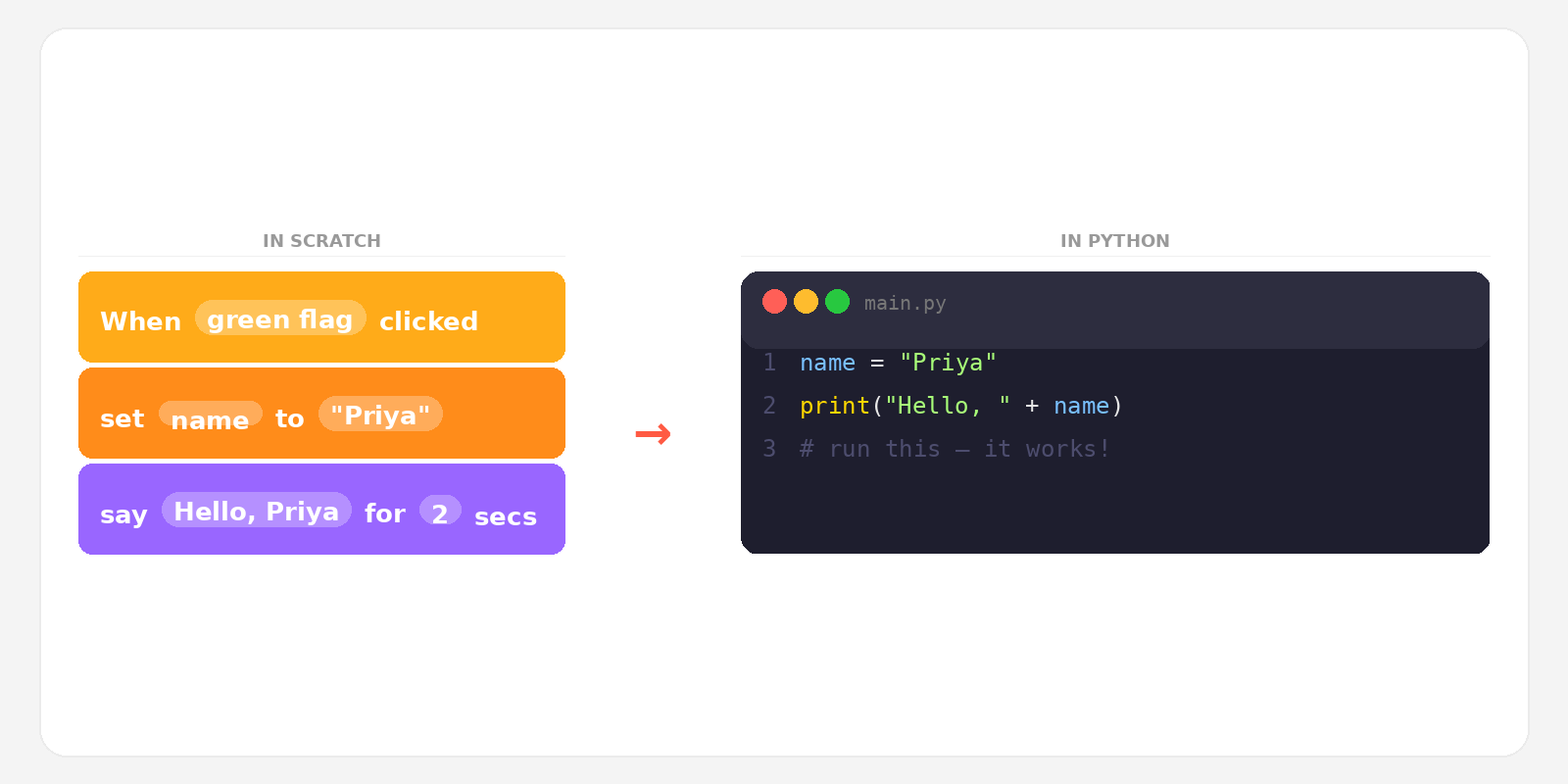
name = "Priya"
print("Hello, " + name)
The logic is identical. The experience is completely different. In Scratch, the structure is provided. In Python, the child has to supply it. Every variable has to be named. Every output has to be written. Nothing happens until the child decides it should.
This is not a punishment. It is precisely the point. When a child has to plan before they type, they are practising the same skill that separates good students from great ones in every subject: thinking before acting. That habit, built through writing code, tends to show up in how they approach essays, maths problems, and science experiments too.
2. Text-based coding for kids teaches them to say exactly what they mean
At home and at school, children get away with being a little vague. “Can you help me with the thing?” works because a parent knows what “the thing” is. “Make it bigger” works because a teacher understands the context.
Code does not work this way. A Python programme does exactly what it is told, nothing more. A missing colon stops it entirely. A spelling mistake in a variable name causes it to fail. There is no guessing, no inferring, no benefit of the doubt.
This sounds frustrating. In practice, it is one of the most useful habits a child can build. Parents often notice it first in other subjects: their child starts re-reading sentences before they submit work, double-checking steps in maths, saying “what I mean is” before restating a point more clearly. They become more careful about what they actually want to communicate, because they have spent time in an environment that rewards precision and catches imprecision every time.
Research on coding and brain development links this kind of disciplined thinking to measurable improvements in planning and self-regulation. A study from MIT Media Lab found that children who learn to write code develop stronger logical reasoning than peers who do not. It is not a technical outcome. It is a thinking outcome.
3. It helps children understand how things connect
Block-based coding teaches children to put steps in the right order. Text-based coding for kids asks something more: what happens to the rest of the programme when this one thing changes?
When a child writes Python, they start to see that everything is connected. A variable set at the top affects what the output looks like at the bottom. A loop that runs one extra time can change the entire result. Changing a function in one place changes every part of the programme that calls it.
Learning to hold all of that in mind at once, to think ahead, to trace cause and effect across a whole system, is the skill that shows up later in science experiments, business decisions, engineering problems, and almost every complex challenge a child will face as an adult. Research on what coding does to a child’s brain confirms that this kind of structured, connected thinking produces measurable cognitive gains. According to a Code.org analysis of independent research, students who study computer science consistently outperform peers in maths and science assessments. Text-based coding for kids builds this capacity in a way that visual block environments rarely need to.
4. Debugging teaches children that failure is useful, not final
When something goes wrong in Scratch, the problem is usually visible. A block is in the wrong place. A loop runs one time too many. The fix is often a matter of looking.
When a Python programme fails, the path to fixing it is longer. The child reads an error message, works out what it is actually telling them, finds the line in their own code where the problem lives, thinks through why it happened, and then tests a solution. If that does not work, they go again.
This is the scientific method, practised in a context where the stakes are low and the feedback is immediate. Children who learn to debug text-based code develop something that is genuinely difficult to teach directly: they stop treating errors as evidence that they cannot do something, and start treating them as information about what to try next. That shift, from “I got it wrong” to “I now know something I did not know before,” carries into every problem they face, inside and outside of code.
5. The move from Scratch to Python works best as a bridge, not a jump
The worry I hear most from parents is that text-based coding for kids will feel too sudden, too abstract, too far from what their child already knows. That is a fair concern. But the difficulty is almost never the language itself. It is the way the transition is handled.
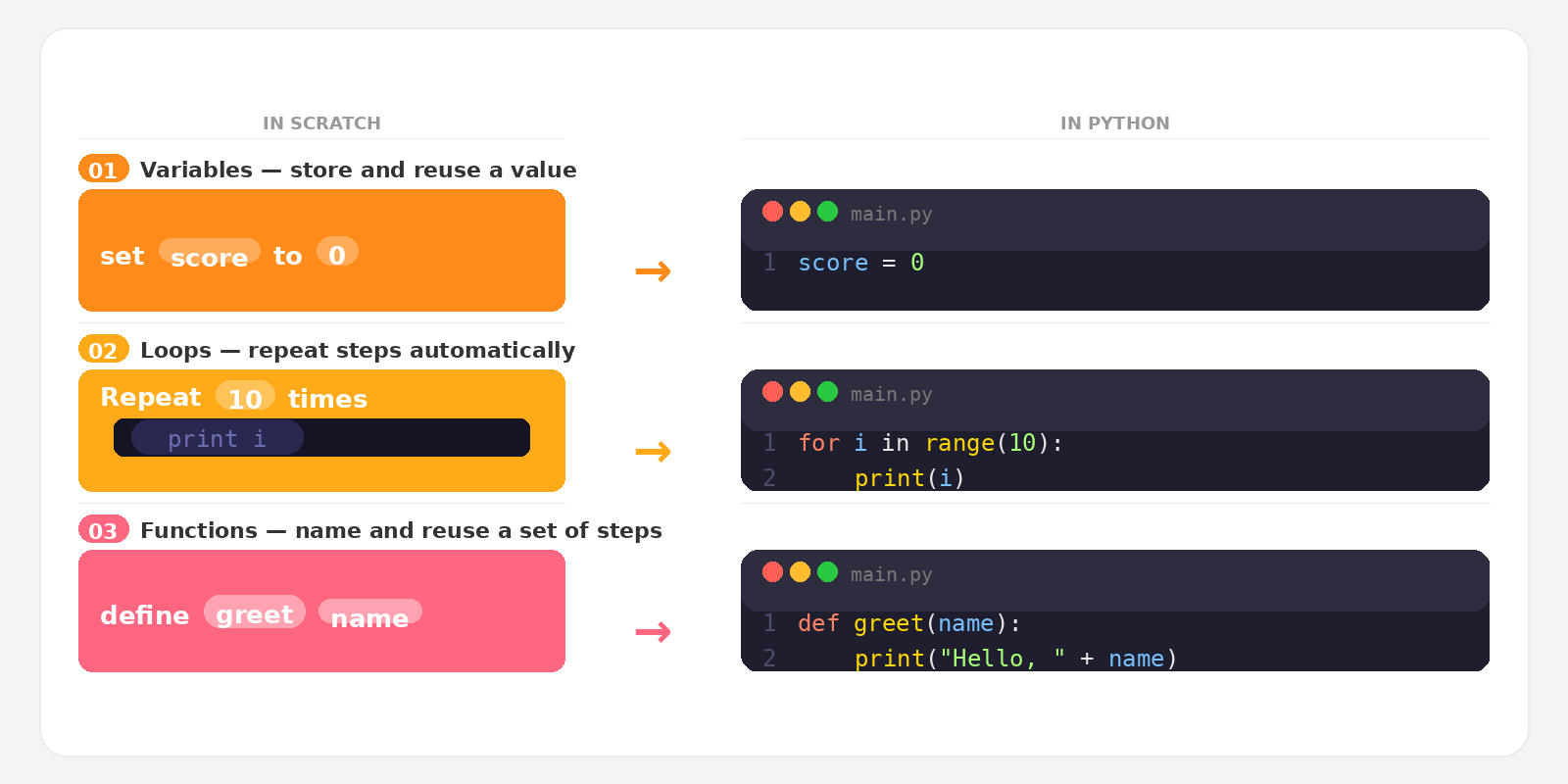
Block-based and text-based coding are not two separate subjects. They are the same ideas written in two different forms. At Codingal, we introduce every Python concept by connecting it directly to something the child already understands from Scratch. Here is what that looks like in practice.
Variables
In Scratch, a child sets a variable with a snap-in block. In Python, the same idea looks like this:
score = 0The child already knows that a variable stores a value and can be changed. All that changes is how they write it, not what it means.
Loops
In Scratch, a “Repeat” block wraps visually around the steps it should run. The child can see the boundary. In Python:
for i in range(10):
    print(i)
The indented lines replace the visual wrapper. The logic is the same: run these steps this many times. The child learns to express that boundary in writing rather than by clicking a block.
Functions
In Scratch, a “My Block” lets a child name a set of steps and reuse them whenever they need to. In Python:
def greet(name):
    print("Hello, " + name)
Same idea. Give a set of instructions a name, then call that name whenever you need the steps to run. The difference is that the child writes the definition rather than clicking a button to create it.
At every point in this bridge, the concept is already familiar before the syntax appears. Nothing changes at the level of logic. What is new is the act of writing it. For most children, this transition lands well from around Class 5, when the ability to think abstractly is developed enough for a blank screen to feel like an invitation rather than an obstacle.
That girl from the beginning of this article, the one who said “this does not look like anything”? By the end of that first session, she had written her first working Python programme. She ran it, read the output on screen, and said: “I made that happen.”
One part surprise. One part pride. One part recognition.
That is not a child who has learned syntax. That is a child who has realised she can build things that did not exist before she sat down. As Co-founder Satyam Baranwal writes, this is the identity shift that changes how a child sees everything they can do. The documented cognitive, academic, and career benefits of coding for children start here. And once a child has crossed from “this does not look like anything” to “I made that happen,” that confidence does not go away.
Take the next step
At Codingal, our curriculum builds text-based coding skills from Class 5 onwards, with a structured bridge from block-based foundations. Every session is live and personalised, with a teacher who knows when to guide and when to let your child work through the problem themselves. Book your child’s free trial class and see that moment for yourself.